98 million kilograms of plastic, cardboard and paper through the front door annually
Two-thirds of consumers find the amount of packaging material used for parcels annoying. Unnoticed, however, they also receive a lot of paper and plastic through regular letterbox mail. In fact, each year consumers receive nearly twice as many plastic mailing wrappers as they do plastic parcel bags. This is because periodicals, such as magazines or club newsletters, are usually enclosed in plastic wrappers, and promotional materials frequently are as well.


Dutch consumers love ordering online, and even more so since the coronavirus pandemic. Almost all of these products are packaged in additional shipping materials, for example to send multiple products as a single parcel and/or as extra protection during transport. A recent limited sample by Mission Reuse, in collaboration with Thuiswinkel.org and the Netherlands Institute for Sustainable Packaging (KIDV), shows that 64% of the 255 surveyed consumers are dissatisfied with the amount of shipping materials delivered with parcels.
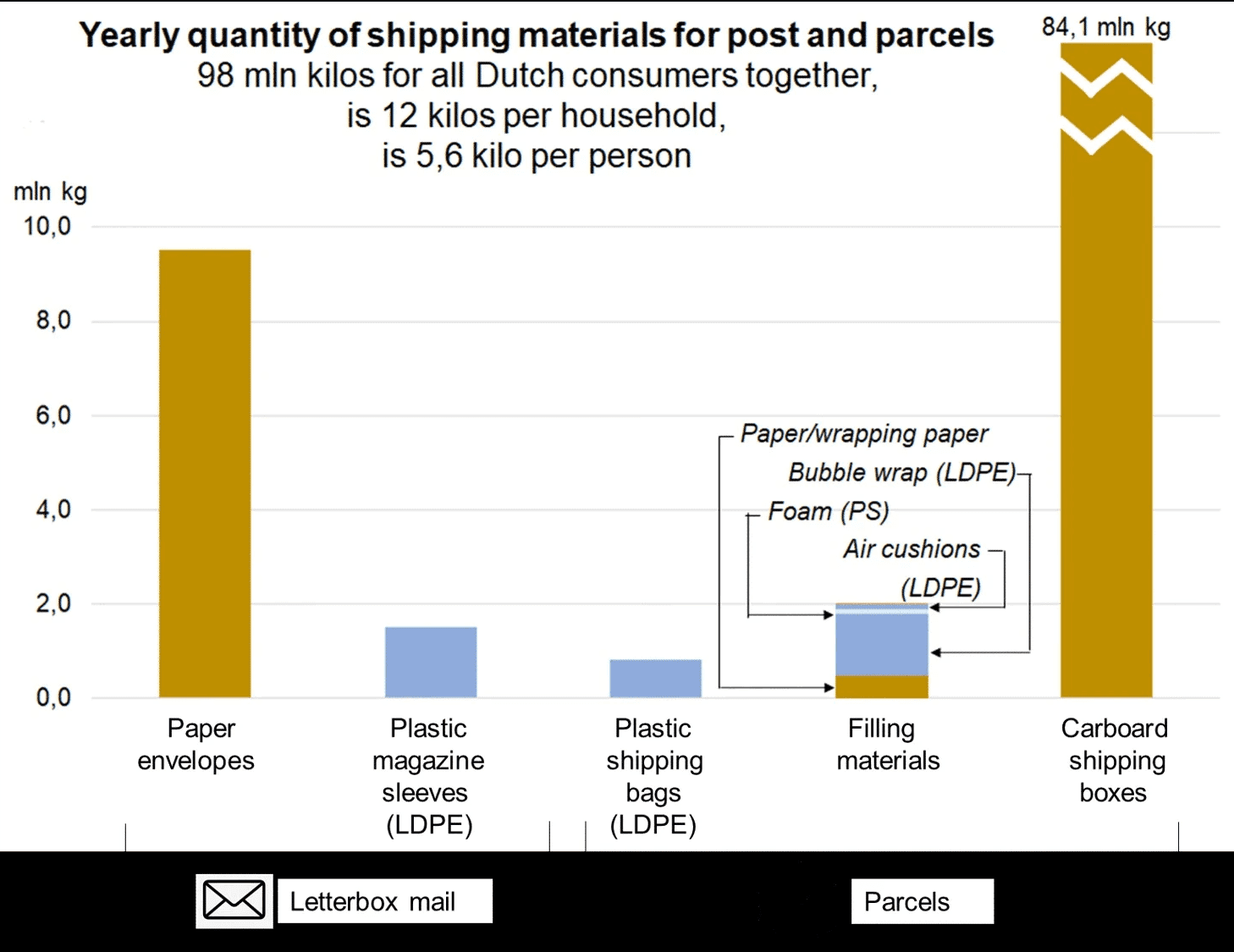
87 million kilos of cardboard and plastic shipping materials via parcels
All these shipping materials are not just an annoyance for consumers. They also place a burden on the environment. Raw materials are needed for their production. Environmentally harmful substances are released during manufacturing. Moreover, because they are single-use, most shipping materials end up in consumer waste.
Recycling Netwerk Benelux has now calculated that annually around 87 million kilos of shipping materials are delivered to doorsteps via parcels. Those 87 million kilos of parcel shipping materials consist of around
84.1 million kilos of cardboard shipping boxes,
0.8 million kilos of plastic shipping bags and
2 million void-fill materials (0.5 million kilos of paper and 1.5 million kilos of plastic, of which 1.3 million bubble wrap).
The void-fill material is mainly found in (rigid) shipping boxes. In addition to the ordered product and void-fill materials, these shipping boxes often contain empty air, which causes an unnecessarily large amount of packaging material and therefore consumption of raw materials. Plastic shipping bags can easily be folded over, and are therefore usually 100% filled with product.
Also 11 million kilos of paper and plastic shipping materials via letters and magazines
However, most people do not realise that a lot of paper and plastic also enters their homes via regular letterbox mail, around 11 million kilos annually.
This consists of:
9.5 million kilos from paper envelopes for letters and other information, and
1.5 million kilos from plastic mailer sleeves for periodicals such as magazines and the like.
The 1.5 million kilos of plastic mailer sleeves equals the amount of plastic void-fill material in cardboard shipping boxes for parcels, and is therefore double the amount of plastic shipping bags for parcels.
The volume of mail delivery has been declining for years, while the volume of parcel delivery has been increasing for years. The focus on parcel delivery is therefore justified. However, the hidden flow of plastic in shipping sleeves for periodicals also deserves attention. This plastic flow is not only substantial, but also easy to prevent using an old-fashioned paper mailer wrapper (address band) or address stickers around the open edge of periodicals. It would be beneficial if the government introduces regulations in the short term, such as a ban on redundant and undesirable shipping packaging, of which plastic mailer sleeves for periodicals are an example.
Shipping materials for mail and parcels mapped out accurately for the first time
Recycling Netwerk Benelux established the above-mentioned quantities of cardboard, paper and plastic for shipping materials by combining quantitative information from various sources and supplementing it with its own measurements. Sources used include the Postal and Parcel Monitor 2020 from the Netherlands Authority for Consumers & Markets, the monitoring report of the sector sustainability plan and other documents from Thuiswinkel.org, the trade association for Dutch online retailers. The complete calculations can be found in Recycling Netwerk's report 'Quantity and environmental impact of shipping materials for mail and parcels for consumers (PDF)'.
Until now, there were estimates from Thuiswinkel.org for the amount of cardboard, paper and plastic for parcels. Substantiation for these estimates was not publicly available. The quantities of paper and plastic shipping materials for regular letterbox mail had never been mapped before, but have now been determined by Recycling Netwerk Benelux. The report describes all calculations in greater detail. Incidentally, the report only maps the shipping materials of mail and parcels to Dutch consumers. Three-quarters of all mail through the letterbox is for consumers, and the rest is for business recipients. Slightly more than half of all parcels entering or leaving the Netherlands are for Dutch consumers. A significant portion of parcels also goes to business recipients or is destined for abroad.
Reusable packaging
Recycling Netwerk, Natuur & Milieu and Enviu have jointly established the Mission Reuse programme to promote reuse. Specifically regarding the sustainability of parcels, Mission Reuse collaborates with the Netherlands Institute for Sustainable Packaging (KIDV) and Thuiswinkel.org.
Consumers are predominantly in favour of reusable shipping materials for parcels. A recent limited sample by Mission Reuse shows that 96% of respondents would like to be able to choose reusable shipping packaging. 49% would actually do so if they had to pay slightly more. In the case of a deposit on shipping materials, as many as 73% choose reusable. The survey is included in the report "Reusable shipping packaging in e-commerce", which also provides an overview of the market and available innovations.
Thuiswinkel.org aims to send 10% of parcels in reusable shipping boxes or bags this year, according to its Sector Sustainability Plan for the e-commerce sector. After all, cardboard shipping boxes are on average only half full. They contain an average of 11.3 litres of air for an average volume of 22 litres, according to a recent interim monitoring report by Thuiswinkel.org.
Thuiswinkel.org also wants to fold shipping boxes more efficiently to reduce the amount of empty air by 10%. Manual folding does not save material, but it does allow more parcels to be transported at the same time. Thuiswinkel also says it wants to use fewer shipping materials, but does not attach any concrete quantitative targets to this.
Recycling Netwerk Benelux mapped the amount of shipping materials commissioned by Zero Waste Europe for the ReuSe Vanguard Project (RSVP). The RSVP project aims for “Reusable solutions for packaging for beverages, take-away drinks and food as well as online delivery get to scale in Europe and become the new normal in the sectors selected”. In the project, the amount of single-use packaging for a large number of products was mapped by Recycling Netwerk Benelux. For seven products, work is now underway to determine how to achieve the transition to reusable (or no) packaging at the European level.
Download the full report here: Recycling Netwerk Benelux, Quantity and environmental impact of shipping materials for mail and parcels for consumers (PDF)
In the news
NOS, Annually 98 million kilos of plastic, cardboard and paper at home due to many parcels and mail
Recycling Magazine, 100 million kilos of plastic and paper at home from mail and parcels 8 February 2022
Ecommerce News, Parcels generate 87 million kilos of cardboard and plastic per year, 9 February 2022
This page is automatically translated. A human review will follow soon.



