Chemical recycling technologies and their role in a circular future for plastics
Chemical recycling is often presented as a solution for hard-to-recycle plastic. This article analyses four technologies: solvent-based extraction, depolymerisation, pyrolysis and gasification, and compares them on operation, quality, costs and climate impact. The analysis shows that chemical recycling offers opportunities, but also has clear technical and system boundaries, and primarily plays a complementary role alongside mechanical recycling.


Chemical recycling is a collective term for processes that break down plastic waste into small building blocks. Where mechanical recycling primarily cleans and reshapes the plastic, chemical recycling goes a step KIDV describes that the input for chemical recycling can consist of complex plastic waste streams such as films and laminates, sorting and recycling losses, and mixed plastic waste. For this reason, it is also labeled by many, for example the RVO, Plastics Europe, VNCI, and the European Commission, as a solution for plastics that cannot be mechanically recycled.
While chemical recycling sounds promising, much remains unclear, partly because the technologies are fairly new and are not yet applied on a large scale[1]. In this article, we want to delve deeper into this: we explain exactly what chemical recycling is, what different technologies exist, and what type of waste streams they can process. In addition, we have published a one-pager, which summarises this article.
An overview of the technologies
There is no single definition of chemical recycling yet, nor is it clearly defined which technologies fall under this term. Indeed, the applied methods differ greatly in the extent to which they break down plastics. For simplicity, we define chemical recycling in this article as the following four technologies:
Dissolution (dissolving and separating the polymer)
Depolymerisation (breaking down into monomers)
Pyrolysis (breaking down into oily products)
Gasification (breaking down into simple gases)
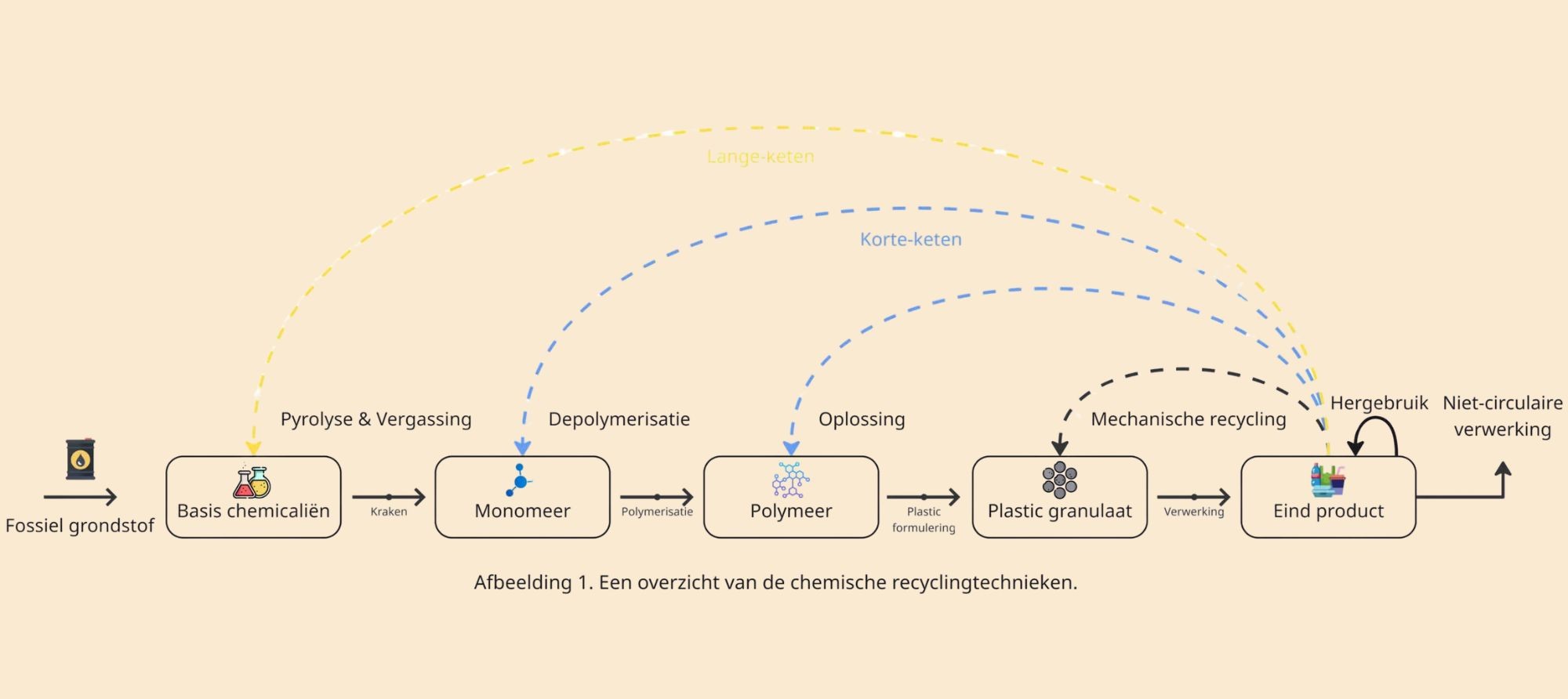
These technologies can be classified o ]. In short-chain processes (dissolution and depolymerisation), the molecular chain remains intact as much as possible and few steps are needed to make useful end products again. Long-chain processes (pyrolysis and gasification), on the other hand, break down plastic further into basic substances, which must then be converted back into usable products by the chemical industry. This requires more energy and process steps, meaning the climate impact is generally higher. Consequently, it can logically be argued that long-chain processes actually fall under chemical recovery rather than chemical recycling.
Let's dive deeper into the processes, quality, costs and limitations of each technology.
Dissolution
In dissolution, also known as physical recycling or solvent-based recycling, the plastic polymer is separated from contaminants without changing the chemical structure of the polymer[4]. Since only the physical properties are modified, this technology is also seen as an advanced form of mechanical recycling, but we categorise it in this article as a chemical recycling process[1].
1. HOW DOES THE PROCESS WORK?
The simplified process is illustrated in Figure 2[1,5,6,7]. After sorting, washing, drying and grinding, the target polymer is dissolved in a suitable solvent. The solvent is chosen so that the polymer becomes soluble, while most contaminants such as labels, inks, fillers or other polymers remain solid. The solid and dissolved contaminants are removed through purification steps. This increases the final quality of the polymer.
The polymer is separated from the solvent via precipitation, dried, and is then suitable for processing into new plastic. The solvent can be purified and reused. Most solvents are non-toxic to humans and the environment.
The efficiency of the method can be very high: with a clean PS input, a theoretical efficiency of 100% is known[1,2].

2. QUALITY OF THE INPUT
In theory, dissolution is suitable for complex plastic streams that are difficult to recycle mechanically, such as metal-laminated films or mixed plastic waste streams. In theory, any polymer can be dissolved if a suitable, selective solvent is available. In practice, this is not (yet) the case, and a homogeneous input and energy are required for efficient separation, in addition to a well-developed solvent[1, 8].
3. QUALITY OF THE END PRODUCT
The process can yield a polymer that closely approaches the quality of virgin plastic, making it attractive for high-quality applications. However, the quality depends heavily on residual contaminants, and the polymers are therefore probably not suitable for food packaging and other contact-sensitive applications[1, 2].
4. COSTS
The KIDV has made a model calculation of the process costs, using the Creasolv process as an example, which converts waste EPS into new PS. With a capacity of 20 kilotonnes of plastic input per year, the investment costs are €26.1 million and the annual operational costs are €12.1 million.
The production costs are €672 per tonne of plastic waste, with energy consumption being the highest cost item. The profit is €962 per tonne of plastic waste, but is highly dependent on the oil price, which determines the price of virgin PS. As capacity increases, production costs decrease.
5. DISADVANTAGES AND LIMITATIONS
While it is theoretically possible to recycle a mixed stream, variations in the input lead to residual contamination because solvents are designed for one specific polymer. This makes the process sensitive to fluctuations in the waste, requiring a homogeneous stream[1].
The process cannot be applied indefinitely: just as in mechanical recycling, polymers are ground and heated during processing, which shortens chains [9].
There is a risk of remaining additives or solvent residues, which can affect product quality.
The technology requires more energy and chemical additives than mechanical recycling[8].
Depolymerisation
Depolymerisation, also known as chemolysis or solvolysis, is a form of chemical recycling where a polymer is broken down into its original building blocks: monomers. This occurs by reaction with chemicals that break the bonds in the polymer chain[10].
The technology works with polymers that have specific bonds, known as condensation polymers. Key examples include PET, PLA, PU and PA[1]. Condensation polymers are sensitive to depolymerisation because their monomers are linked by reactive bonds that are chemically more vulnerable than, for example, carbon bonds in PE or PP. As a result, they can be relatively easily ‘broken back’ with chemicals into shorter chains or loose monomers [11]. In addition, the technology is applied by Trinseo to PMMA, a monomer with a very low plastic market share, used as a replacement for glass, among other things.
1. HOW DOES THE PROCESS WORK?
There are different forms of depolymerisation, depending on the reactant used, such as hydrolysis (reaction with water), glycolysis (reaction with glycol), alcoholysis (reaction with alcohol), and methanolysis (reaction with methanol). Each method yields different monomers[1, 10]
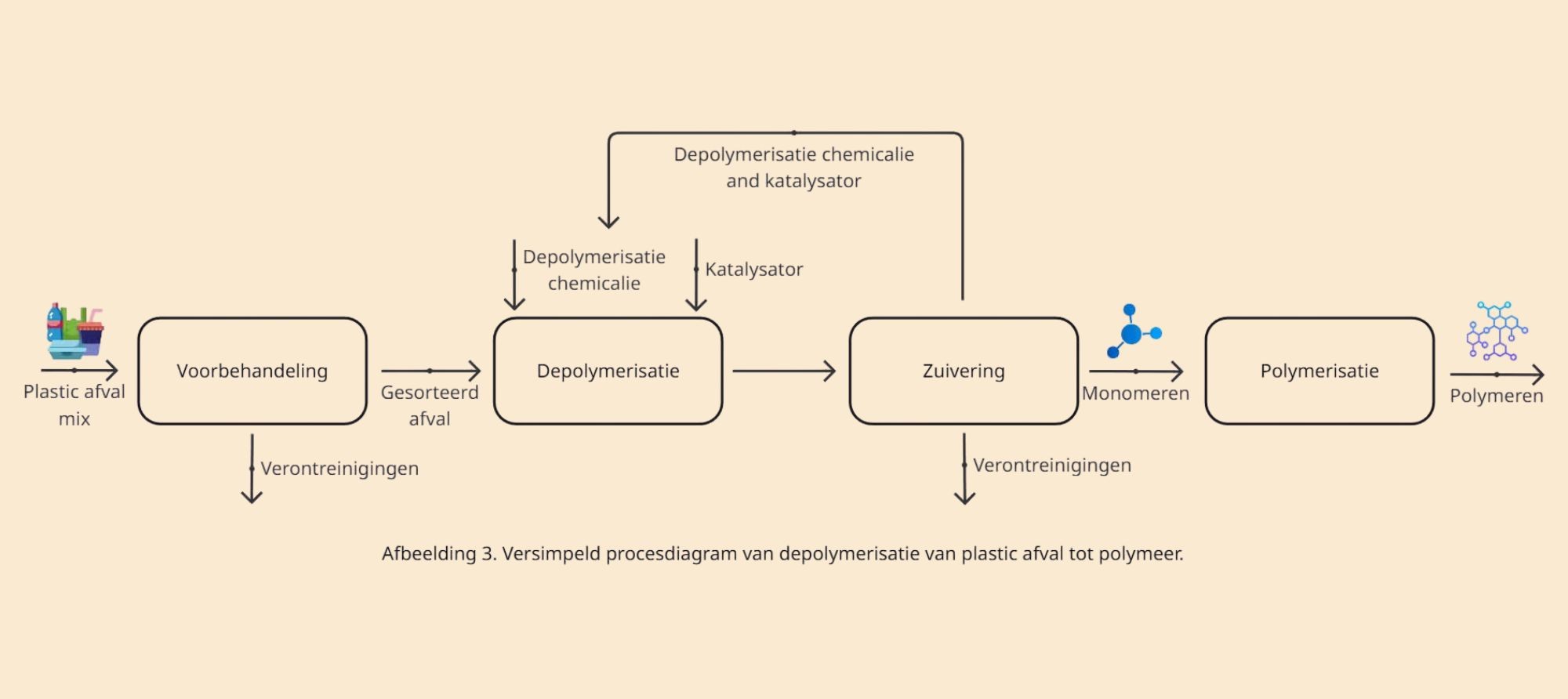
The process is illustrated in Figure 3[1, 10]. After pre-treatment of the plastic waste, the polymer chains are broken down into monomers or oligomers using a specific chemical and a catalyst. Residual contaminants, catalyst residues and by-products are removed in purification steps (precipitation, filtration, distillation). The catalyst and the reactant used can generally be recovered and reused. The end product is a pure monomer, which can then be polymerised to make new plastic.
When using a sorted PET input, a plastic-to-plastic efficiency of approximately 97% can be achieved[5].
2. QUALITY OF THE INPUT
The input must be relatively homogeneous and pure. How much contamination is possible has not yet been well established technically, but it is known that contaminants disrupt the chemical reaction[12].
3. QUALITY OF THE END PRODUCT
A major advantage of depolymerisation is that there is no loss of quality: the monomers are of the same quality as virgin monomers[1]. This makes it possible to produce high-quality applications, such as food packaging, and recycle them more often than via mechanical routes.
4. COSTS
The KIDV has made a model calculation of the process costs, using PET glycolysis as an example. With a capacity of 20 kilotonnes of plastic input per year, the investment costs are €18.7 million and the annual operational costs are €11.2 million.
The production costs are €605 per tonne of plastic waste, with the highest costs lying in energy consumption. The profit is €307 per tonne of plastic waste, but the process scale, oil price and plastic waste price all have a major impact on profit.
5. DISADVANTAGES AND LIMITATIONS
The method requires highly pure inputs, as contaminants disrupt the chemical reaction. This makes pre-treatment and sorting crucial, leading to more loss [1,8].
Not enough is yet known about how much variation in waste streams the process can tolerate[1].
The technology requires more energy and more chemical additives than mechanical recycling[8].
The technology is only applicable to a limited number of polymers (condensation polymers).
Pyrolysis
Pyrolysis, also known as thermal cracking or thermolysis, is a chemical recycling technology in which plastic is broken down into small hydrocarbons by heating it strongly in the absence of oxygen. The reaction usually takes place at 200-900oC, depending on the process design. The result is a mixture of products, the most important of which is pyrolysis oil, along with gases, waxes and char[1].
Because pyrolysis is a random cracking process, it produces a complex mixture that requires intensive and costly purification before it can be used as a raw material in the chemical industry [12]. Much research is currently being conducted into catalytic pyrolysis, in which catalysts help to make targeted products at lower temperatures. Whether these techniques will become feasible on a large scale remains to be seen in the coming years[13].
1. HOW DOES THE PROCESS WORK?
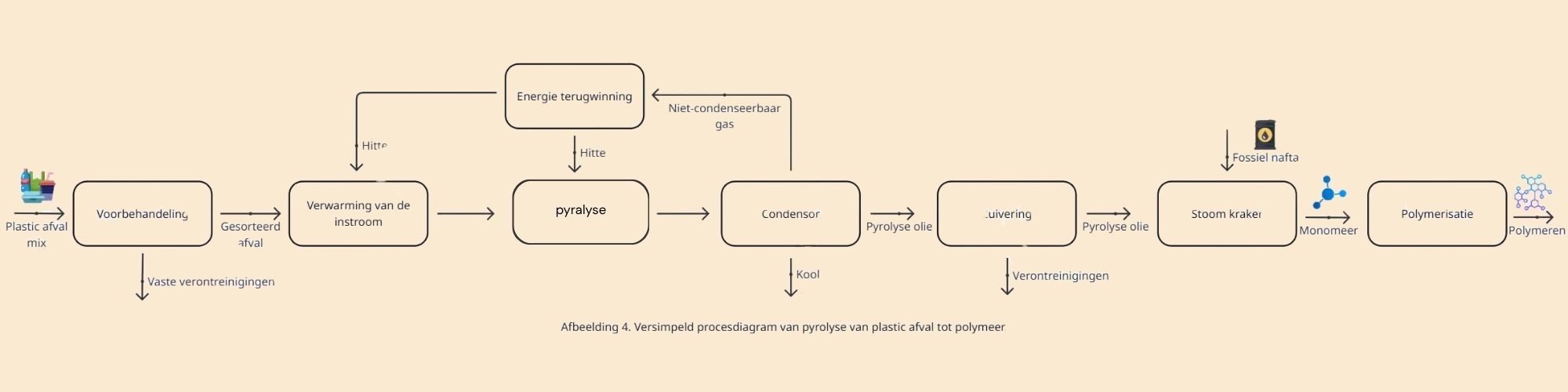
The pyrolysis process is illustrated in Figure 4 [12, 13, 14]. In the pyrolysis reactor, the plastic waste is heated and the polymers are broken down. The vapours from the process are cooled, separating the condensable pyrolysis oil from the non-condensable gases. These gases are often burned directly to provide heat for the process.
To process the pyrolysis oil into usable products, it must be co-fed into a steam cracker, which is the most widely used technology to produce plastics from fossil naphtha (crude oil) [1, 12, 13, 14, 15]. Steam cracking requires a predictable and highly pure input, and untreated pyrolysis oil often contains high concentrations of contaminants, such as chlorine, nitrogen, and oxygen-containing compounds, which are harmful to safety and the plant. Therefore, extensive purification is required before the oil can be added to a cracker, which requires high energy input. In practice, pyrolysis oil is only blended up to about 5-10% [14, 16, 17] with fossil naphtha because the chemical composition of the oil still varies greatly. As a result, only a small portion of the basic chemicals for plastics produced by a steam cracker comes from recycled material. There are developments, such as CoolBrook which cracks 100% pyrolysis oil, but those methods are not yet scalable.
Because pyrolysis oil is always mixed with fossil naphtha for plastic production, the recyclate is chemically indistinguishable from fossil material. The European Commission therefore prescribes that mass balances be used to calculate the proportion of recycled plastic in the final product. The plastic-to-plastic efficiency is around 49% according to the fuel-exempt mass balance principle[2]. There are snags to this calculation method, but we will not go into them in this article. This one-pager by Zero Waste Europe outlines an overview of the problems with mass balance calculations.
2. QUALITY OF THE INPUT
Pyrolysis is presented to the market as a technology suitable for processing plastic streams that still contain contamination. In this context, that means contamination with other waste or inks, additives or other polymers. However, there is still a limit to the amount of contamination possible, and pyrolysis operators require a maximum contamination of 15%[13].
Pyrolysis is most suitable for plastics with a carbon-carbon bond, such as PE and PP. These polymers yield an oil that most closely resembles fossil naphtha. Plastics with oxygen (PET) or chlorine (PVC) are unsuitable due to the formation of undesirable by-products such as acids and hydrogen chloride. Pyrolysis of PS and PMMA is technically possible but requires extra purification[8, 18]. Scientific research is underway into the possibilities for pyrolysis of PET, for example with the use of catalysts[13].
3. QUALITY OF THE END PRODUCT
When well-purified pyrolysis oil is blended in small quantities into a cracker, basic chemicals are produced that are identical to fossil chemicals. This allows plastics recycled via pyrolysis to be used again for high-quality applications. The temperature and the composition of the input strongly determine the chemical composition of the pyrolysis oil[1, 18].
4. COSTS
The KIDV has made a model calculation of the process costs of fast, low-temperature pyrolysis. The calculation takes into account a negative price for the plastic waste input, as they expected off-takers to be paid to process this stream. With a capacity of 30 kilotonnes of input per year, the investment costs are €25.4 million and the annual operational costs are €8.0 million.
The production costs are €310 per tonne of plastic waste, with the highest costs lying in labour and not energy consumption, since the generated gases can be burned for process heat. The profit is €100 per tonne of plastic waste, but this is only calculated for the production of diesel, naphtha and gas and no further processing into plastics.
5. DISADVANTAGES AND LIMITATIONS
The process is very energy-intensive and requires high temperatures.
The composition of pyrolysis oil is highly variable, making heavy purification and blending with fossil naphtha necessary. As a result, chemical recyclate from pyrolysis oil remains dependent on a fossil infrastructure.
Substances of Very High Concern (SVHC) can be present in pyrolysis oil or even be created during the process. Post-treatment removes some of these substances, but it is unknown how much SVHC ultimately remains in purified pyrolysis oil[13].
PVC and PET can disrupt the process.
A mass balance administration is required, because recycled and virgin hydrocarbons mix completely and are physically indistinguishable.
Gasification
Gasification is a chemical recycling technique in which plastic is converted into a synthesis gas (syngas): a mixture of carbon monoxide (CO), hydrogen (H2), carbon dioxide (CO2), methane (CH4) and light hydrocarbons. Syngas can be used as a raw material for new chemicals, fuels or – after many additional process steps – as a base for plastic production[17]. Gasification is carried out at very high temperatures between 800 and 1500oC, in the presence of a controlled amount of oxygen[19].
The technique is less sensitive to variations in the waste stream than pyrolysis, but requires significantly more energy, higher temperatures and a larger industrial plant scale. Consequently, the Versnellingshuis Chemische Recycling states that gasification is only possible on large industrial sites with extensive safety facilities, such as Chemelot or the Botlek in the Netherlands.
1. HOW DOES THE PROCESS WORK?
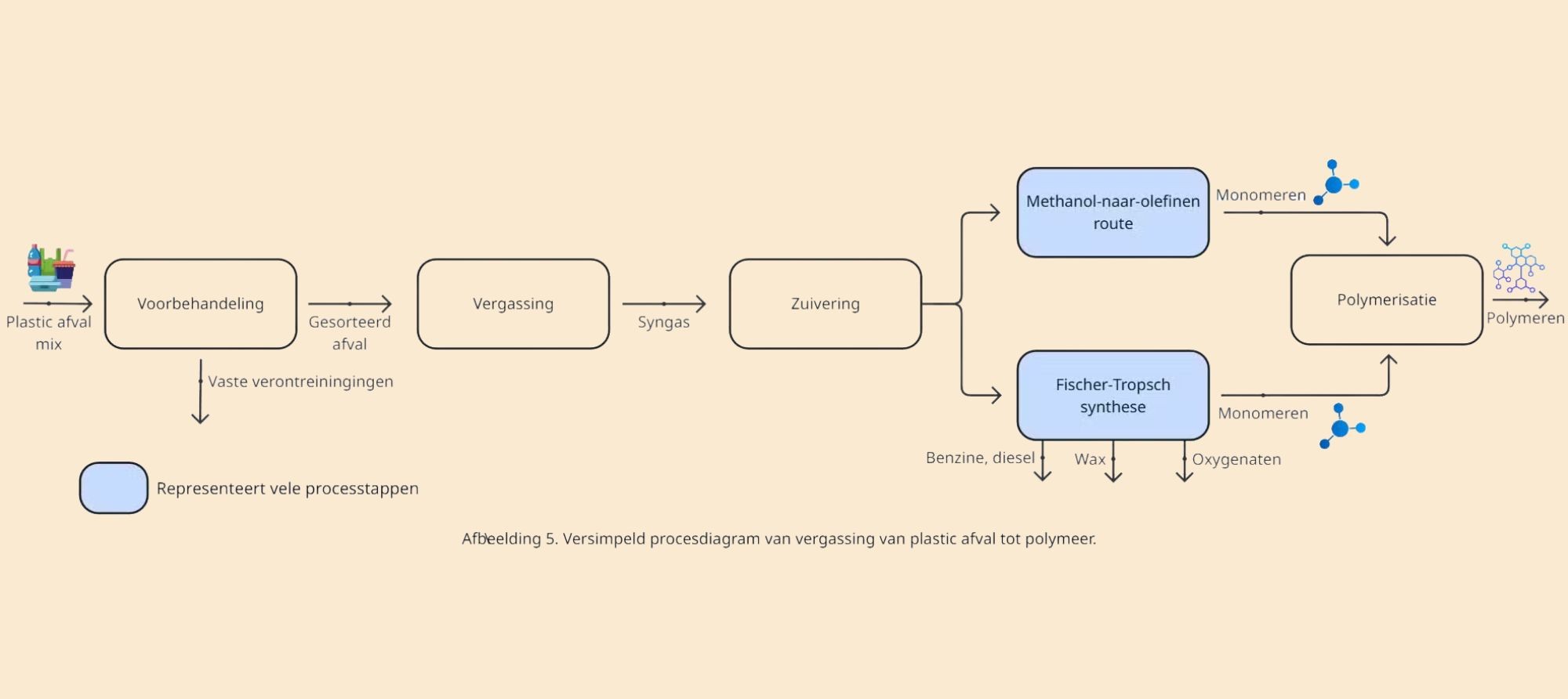
The steps of the gasification process are illustrated in Figure 5[1, 5, 19, 20]. After sorting and drying the waste, where it is sometimes mixed with biomass, the material is heated. The polymers thereby break down completely into simple gas molecules, i.e., syngas. Technically, the process is similar to gasifying coal or biomass, but the thermal stability of plastics makes traditional gasifiers less suitable for this application.
Syngas often contains contaminants, such as sulphur or chlorine compounds, which must be removed to prevent damage to equipment. Only after extensive cleaning can syngas be converted into other products, such as ammonia (raw material for fertilizer), synthetic fuels, ethanol (one of the few commercial applications on a larger scale), and plastics. New plastics can be produced through processes such as Methanol-to-Olefins (MTO) and Fischer-Tropsch synthesis. These routes require many extra process steps to obtain olefins (PE, PP) from syngas[21, 22].
The plastic-to-plastic efficiency of the process is 34%, which is significantly lower than pyrolysis due to the extra process steps to process syngas into usable end products[2].
2. QUALITY OF THE INPUT
Gasification can process almost all plastics, as long as they have a high carbon content. The method is less sensitive to input quality than pyrolysis, and in practice, mixed or contaminated streams are also gasified[1].
3. QUALITY OF THE END PRODUCT
Syngas is a low-value raw material compared to pyrolysis oil because it consists of very simple molecules. The use of syngas for new plastic is very limited, and in practice, it is mainly used for energy generation, fuel production and basic chemicals such as ammonia[2].
4. COSTS
The KIDV has made a model calculation of the process costs of high-temperature gasification of sorting residue. The calculation takes into account a negative price for the plastic waste input. With a capacity of 100 kilotonnes of input per year, the investment costs are €81.9 million and the annual operational costs are €40.8 million.
The production costs are €449 per tonne of plastic waste, with the highest costs lying in the requirement of industrial gases. The profit is negative at €-89 per tonne of plastic waste, but assumes that methanol is made with the obtained syngas.
5. DISADVANTAGES AND LIMITATIONS
The process requires very high temperatures and thus a lot of energy.
Complex post-treatment steps are required to purify syngas and convert it to plastics, resulting in low overall plastic-to-plastic efficiency and high climate impact.
The energy content of syngas is lower than that of natural gas, which makes its use as synthetic natural gas less attractive[1]
Compatibility of plastic types per recycling technology
Not every chemical recycling technology is suitable for every type of plastic and every type of product. Suitability depends, among other things, on the chemical structure of the polymer, the presence of contaminants in the waste and the target product. Table 1 summarises an overview of which plastics can be processed via dissolution, depolymerisation, pyrolysis and gasification.

Table 1. The plastic types processable per chemical recycling method[1, 12, 13].
Conclusion and next steps
Chemical recycling offers important opportunities for difficult plastic streams that would otherwise not be recycled or only downcycled. The technologies have the potential to produce polymers with virgin quality, which can be used in high-quality applications.
At the same time, these technologies are still in a relatively early stage of development technically. For many processes, it is still uncertain how stably they run, how much variation in waste streams they can handle and how far technological improvements, such as catalysts that can make processes more efficient, will actually develop. Furthermore, not every type of plastic can be processed: depolymerisation only processes condensation polymers such as PET and PA, and PMMA, while pyrolysis is mainly suitable for PE and PP and less so for PVC or PET.
In addition, the different technologies have their own system limitations. A major challenge for short-chain processes is the limited tolerance for contaminants, making them dependent on well-sorted and washed, homogeneous inputs. This makes scaling up complex, despite the relatively high plastic-to-plastic efficiency. For long-chain processes, the low plastic-to-plastic efficiency, the necessary extra process steps to make polymers again from pyrolysis oil or syngas, and the associated climate impact present major limitations.
Therefore, chemical recycling is still primarily an additional, rather than a self-evident, solution for plastic waste. Fair Resource Foundation will conduct further research into these technologies in the coming period, so that we can provide more clarity in the future about their actual potential and role in the transition to a circular plastic chain.
References
Hann, S., & Connock, T. (2020). Chemical recycling: state of play. Eunomia Research & Consulting Ltd. ↑
Broeren, M., Uijttewaal, M., & Bergsma, G. (2024). Monitoring chemical recycling: how to include chemical recycling in plastic recycling monitoring. CE Delft.↑
Versnellingstafel Chemische Recycling van Kunststoffen. (2023). Whitepaper Chemische Recycling.↑
Klotz, M., Oberschelp, C., Salah, C., Subal, L., & Hellweg, S. (2023). The role of chemical and solvent-based recycling within a sustainable circular economy for plastics. The Science Of The Total Environment, 906, 167586. ↑
Broeren, M., Lindgreen, E. R., & Bergsma, G. (2019). Verkenning chemische recycling: update 2019. CE Delft.↑
Solvent-based plastics recycling. (2025). Fraunhofer Institute For Process Engineering And Packaging IVV. ↑
Imholz, N., Schwarz, A., & M, B. (2025). Klimaatimpact van circulaire plastics: mechanisch recyclaat, chemisch recyclaat en biobased plastic. CE Delft.↑
Crippa, M., De Wilde, B., Koopmans, R., Leyssens, J., Linder, M., Muncke, J., Ritschkoff, A.-C., Van Doorsselaer, K., Velis, C., & Wagner, M. (2019). A circular economy for plastics: Insights from research and innovation to inform policy and funding decisions. European Commission EC. ↑
Achilias, D. S. (2025). Thermo-chemical recycling of plastics as a sustainable approach to the plastic waste issue. Euro-Mediterranean Journal For Environmental Integration, 10(4), 2605–2618.↑
Fakirov, S. (2018). Condensation polymers: their chemical peculiarities offer great opportunities. Progress in Polymer Science, 89, 1–18. ↑
Rizos, V., Urban, P., Righetti, E., & Kassab, A. (2023). Chemical recycling of plastics: technologies, trends and policy implications. CEPS.↑
Heens, F., Bakker, J., De Boer, L., Broekman, M., M, J., Sanders, M., & Lijzen, J. (2023). Pyrolyse van kunststofafval: zeer zorgwekkende stoffen in pyrolyse-olie voor de kunststofketen. RIVM.↑
Lim, S. H., Pham, H. H., Kwon, E. H., & Nho, N. S. (2025). Optimizing the use of pyrolysis waste oil as a feedstock for the naphtha cracking process by hydrotreating and hydrocracking. Resources Environment And Sustainability, 22, 100277. ↑
Rajan, K. P., Mustafa, I., Gopanna, A., & Thomas, S. P. (2023). Catalytic Pyrolysis of Waste Low-Density Polyethylene (LDPE) Carry Bags to Fuels: Experimental and Exergy Analyses. Recycling, 8(4), 63. ↑
Zero Waste Europe. (2023). Leaky Loop “ recycling: A technical correction on the quality of pyrolysis oil made from plastic waste.Wentzel, B. (n.d.). Verhitten zonder zuurstof: de opmars van pyrolyse. VNCI.↑
Wentzel, B. (n.d.). Verhitten zonder zuurstof: de opmars van pyrolyse. VNCI.↑
Xayachak, T., Haque, N., Parthasarathy, R., King, S., Emami, N., Lau, D., & Pramanik, B. K. (2022). Pyrolysis for plastic waste management: An engineering perspective. Journal Of Environmental Chemical Engineering, 10(6), 108865. ↑
Shah, H. H., Amin, M., Iqbal, A., Nadeem, I., Kalin, M., Soomar, A. M., & Galal, A. M. (2023). A review on gasification and pyrolysis of waste plastics. Frontiers in Chemistry, 10, 960894. ↑
Maier, M., Schulze-Netzer, C., & Adams, T. A. (2024). Chemical Recycling of Plastic Waste via Production of Ethylene from Gasification Syngas. Industrial & Engineering Chemistry Research, 64(1), 575–589. ↑
Chen, Y., Wei, J., Duyar, M. S., Ordomsky, V. V., Khodakov, A. Y., Liu, J., (2021). Carbon-based catalysts for Fischer–Tropsch synthesis. Chemical Society Reviews, 50(4), 2337–2366. ↑
Dimian, A. C., & Bildea, C. S. (2017). Energy efficient methanol-to-olefins process. Process Safety And Environmental Protection, 131, 41–54.↑
This page is automatically translated. A human review will follow soon.