Recycling Netwerk in the media
February The petition motion by Merijn Tinga, the Plastic Soup Surfer, was signed by all democratic parties in the House of Representatives. May Litter policy in Flanders falls short. Litter increased by forty percent, according to a study by the research consultancy KplusV on behalf of the OVAM. June The Flemish government […]

February
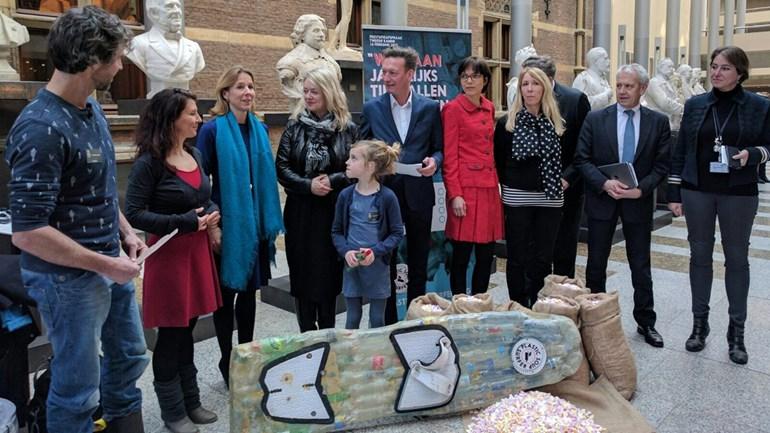
The petition motion of Merijn Tinga, the Plastic Soup Surfer, was signed by all democratic parties in the House of Representatives.
May
Litter policy in Flanders falls short. Litter increased by forty percent, according to the study by research agency KplusV commissioned by the OVAM.
June
The Flemish government refuses to introduce a ban on plastic bags. The Brussels and Walloon Region are, however, proceeding with a ban.
The recycling of plastics in the Netherlands must improve in order to achieve more environmental benefits (NOS Journal how Dutch people recycle https://www.npo.nl/nos-journaal/26-06-2017/POW_03375642
The Guardian reveals that 1 million plastic bottles per minute are produced worldwide.
July
The Plastic Soup Surfer arrives in the Netherlands after a 1200 km journey on a SUP board made of recycled plastic. Artist Merijn Tinga made the trip to raise awareness of plastic waste in inland waterways. This waste eventually ends up in the sea and contributes to the plastic soup problem.
August
Recycling Netwerk requests that the modification of the blue bag is accompanied by the introduction of a deposit system in Flanders. http://deredactie.be/cm/vrtnieuws/videozone/programmas/journaal/2.51429?video=1.3045719
https://nieuws.vtm.be/binnenland/voer-statiegeld-op-pet-fles-en-blikjes
The Dutch supermarket Aldi stops selling plastic bags.
September
Recycling Netwerk files a complaint against the industry that scatters environmentally polluting rubber crumbs as rubber granulate on and under artificial turf pitches.
The Dutch research agency CE Delft finalises the study commissioned by State Secretary Sharon Dijksma (PvdA) on the costs and savings yielded by a deposit system. The conclusion is that deposits decimate litter. Dijksma declares that the next government can make a quick decision.
The government policy statement of the new Dutch cabinet Rutte III is very thin on the circular economy.
The Netherlands Bureau for Economic Policy Analysis (CPB) sees a solution in a deposit system.
The September Declaration of the Flemish government says little about the circular economy.
Flemish Environment Minister Joke Schauvliege (CD&V) declares in the Flemish parliament that she is in favour of introducing a deposit system.
Scottish First Minister Nicola Sturgeon (SNP) decides on the introduction of a deposit system in Scotland.
The Belgian magazine Knack publishes an extensive feature story about the waste policy in Flanders. http://www.knack.be/nieuws/belgie/waarom-zwerfvuil-niet-opgeruimd-geraakt/article-longread-899453.html
October
The Dutch investigative programme Zembla reveals in the report ‘Down to the Bottom’ that the use of rubber granulate on and under artificial turf pitches is potentially harmful to the environment. Among others, Recycling Netwerk contributed to the programme. https://zembla.bnnvara.nl/nieuws/tot-op-de-bodem
The Belgian weekly magazine HUMO runs 4 pages on the plastic issue, titled "The plastic apocalypse".
De Standaard reveals that the packaging industry pays the salaries of civil servants who monitor litter via Mooimakers. This gives rise to questions in the Flemish Parliament. https://www.youtube.com/watch?time_continue=7900&v=lKnLbafD33s
Coca-Cola agrees to the introduction of a deposit system across the entire United Kingdom.
November
The Deposit Alliance (Statiegeldalliantie) starts with 21 partners. It is a unique collaboration between organisations from the Netherlands and Flanders.
There are some notable partners involved: the largest Flemish women's movement KVLV, the Dutch municipality of Weert, and the largest Belgian consumer organisation Test Aankoop / Test Achats.
The Deposit Alliance was also discussed in the plenary session of the Flemish Parliament.
https://www.trouw.nl/groen/met-de-belgen-in-actie-voor-statiegeld-op-alle-flessen-en-blik~aef31af9/
NOS News of 27 November, 8 pm, from 12:40
https://www.kijk.nl/sbs6/hartvannederland/videos/v7glqyP3eTMg/wat-vindt-nederland-moet-er-statiegeld-komen-op-kleine-plastic-flessen-en-blikjes
A poll by Hart Van Nederland shows that 76% of the Dutch consider the introduction of a deposit system a good idea. A poll by RTL Nieuws also shows that 77% of the Dutch want a deposit system introduced.
RTL Nieuws also lists all the arguments neatly.
https://www.rtlnieuws.nl/economie/statiegeld-op-plastic-ja-graag
The Senate in Belgium calls on the governments of the Belgian regions of Flanders, Brussels and Wallonia for the rapid introduction of a deposit system.
Belgian State Secretary Philippe De Backer (Open VLD) launches a plan against the pollution of the North Sea.
Recycling Netwerk announces the launch of its BackToSender campaign. The action immediately goes viral. Dutch and Flemish people send, via Twitter alone,
February
The petition motion of Merijn Tinga, the Plastic Soup Surfer, was signed by all democratic parties in the House of Representatives.
May
Litter policy in Flanders falls short. Litter increased by forty percent, according to the study by research agency KplusV commissioned by the OVAM.
June
The Flemish government refuses to introduce a ban on plastic bags. The Brussels and Walloon Region are, however, proceeding with a ban.
The recycling of plastics in the Netherlands must improve in order to achieve more environmental benefits (NOS News how Dutch people recycle https://www.npo.nl/nos-journaal/26-06-2017/POW_03375642
The Guardian reveals that 1 million plastic bottles per minute are produced worldwide.
July
The Plastic Soup Surfer arrives in the Netherlands after a 1200 km journey on a SUP board made of recycled plastic. Artist Merijn Tinga made the trip to raise awareness of plastic waste in inland waterways. This waste eventually ends up in the sea and contributes to the plastic soup problem.
August
Recycling Netwerk requests that the modification of the blue bag is accompanied by the introduction of a deposit system in Flanders. http://deredactie.be/cm/vrtnieuws/videozone/programmas/journaal/2.51429?video=1.3045719
https://nieuws.vtm.be/binnenland/voer-statiegeld-op-pet-fles-en-blikjes
The Dutch supermarket Aldi stops selling plastic bags.
September
Recycling Netwerk files a complaint against the industry that scatters environmentally polluting rubber crumbs as rubber granulate on and under artificial turf pitches.
The Dutch research agency CE Delft finalises the study commissioned by State Secretary Sharon Dijksma (PvdA) on the costs and savings yielded by a deposit system. The conclusion is that deposits decimate litter. Dijksma declares that the next government can make a quick decision.
The government policy statement of the new Dutch cabinet Rutte III is very thin on the circular economy.
The Netherlands Bureau for Economic Policy Analysis (CPB) sees a solution in a deposit system.
The September Declaration of the Flemish government says little about the circular economy.
Flemish Environment Minister Joke Schauvliege (CD&V) declares in the Flemish parliament that she is in favour of introducing a deposit system.
Scottish First Minister Nicola Sturgeon (SNP) decides on the introduction of a deposit system in Scotland.
The Belgian magazine Knack publishes an extensive feature story about the waste policy in Flanders. http://www.knack.be/nieuws/belgie/waarom-zwerfvuil-niet-opgeruimd-geraakt/article-longread-899453.html
October
The Dutch investigative programme Zembla reveals in the report ‘Down to the Bottom’ that the use of rubber granulate on and under artificial turf pitches is potentially harmful to the environment. Among others, Recycling Netwerk contributed to the programme. https://zembla.bnnvara.nl/nieuws/tot-op-de-bodem
The Belgian weekly magazine HUMO runs 4 pages on the plastic issue, titled "The plastic apocalypse".
De Standaard reveals that the packaging industry pays the salaries of civil servants who monitor litter via Mooimakers. This gives rise to questions in the Flemish Parliament. https://www.youtube.com/watch?time_continue=7900&v=lKnLbafD33s
This page is automatically translated. A human review will follow soon.



