Manifesto of businesses and municipalities: "recycling is not the solution to the waste problem, reuse is"
Businesses, trade associations, municipalities and NGOs are calling on the House of Representatives to invest in a strong reuse sector. They are asking for legal standards, greater producer responsibility and a redistribution of subsidies. ‘More recycling is not the solution to combat mountains of waste, litter and rising social costs. Reusable packaging is,’ say the signatories of the manifesto that was handed over to MPs.


Benefits of reuse
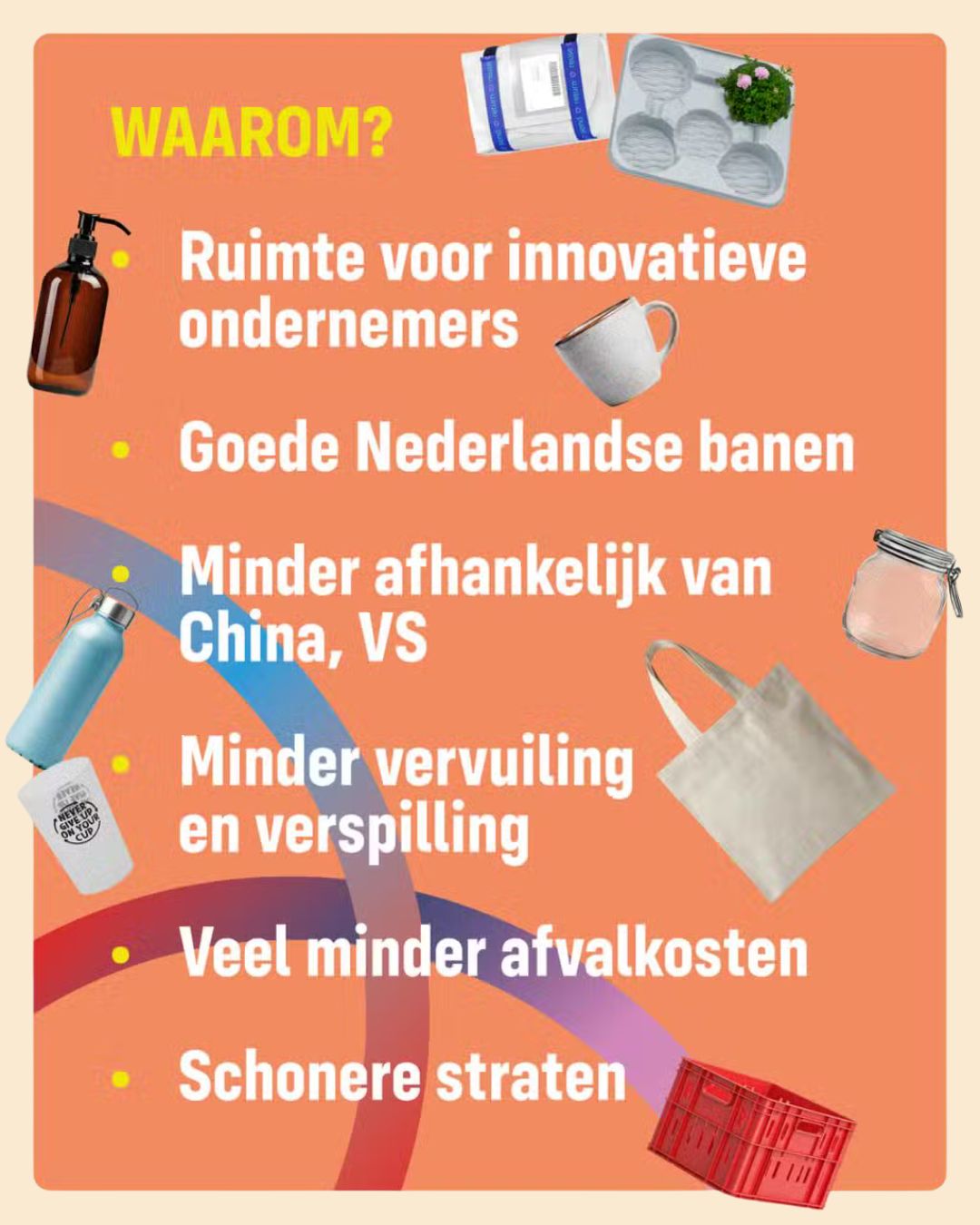
‘’With reusable packaging, we not only reduce our environmental impact, we build a stronger economy with room for innovative entrepreneurs and less dependence on foreign raw materials for our packaging or events such as suddenly rising energy costs,‘’ says initiator Karl Beerenfenger of Fair Resource Foundation on behalf of the coalition.
The 66 signatories, including the four major cities and the umbrella organisation of circular companies (NVCE), are asking politicians for ambitious reuse targets, an end to erratic policies so that companies can invest with certainty, responsibility for producers to make reuse of their products easier, redistribution of financial support so that reuse is not priced out of the market by subsidised recycling and an exemplary role for the government in its procurement.
Jacolien Eijer-de Jong, director of the Dutch Association of Waste and Cleaning Services, says: “We really have to get used to the idea that packaging can be reused, just as we are finding this increasingly normal for smartphones and clothing.’’
Unprecedented scale of packaging market and issues
We are using more and more packaging waste. In 2023, 80 million tonnes of packaging waste was produced in the European Union, or 178 kg per inhabitant. Of all packaging, only a small amount is recycled to a high standard – the rest ends up in low-value applications, landfills, is incinerated, or ends up as litter in the environment.
Eijer-de Jong: ‘’The increase in single-use packaging absolutely does not fit a circular society. We are not going to recycle our way to a circular economy, there is simply still too much waste generated at the moment.’’ Wageningen University calculated last year that only 36% of plastic packaging is currently easily recyclable. ‘’Municipalities can collect as well as they want, but it only contributes to more circularity to a limited extent. In fact, they are only mopping up as best as they can, while that tap really needs to be turned off’’, according to Eijer-de Jong.
‘’When looking at the high percentages of recycled and reused packaging that sometimes pop up in the Netherlands, weight is looked at, and heavy, reusable items such as pallets, roll containers and beer bottles are included. As a result, the figures give a highly distorted picture’’, Karl Beerenfenger of Fair Resource Foundation explains.
Municipalities and entrepreneurs unite
Fourteen municipalities signed the manifesto, including The Hague. Alderman Arjen Kapteijns explains: ‘’The waste bins in our municipality are full of single-use packaging waste, and the living environment is littered with it. We incur huge costs for processing and cleaning up, which we partly have to pass on to our residents. While it is precisely the companies that put the packaging on the market that should bear those costs.’’
Nine out of the ten most commonly found items in litter are packaging, including bottles, caps, cups, plates, food containers and bags. The signatories also see a 'worrying trend' in packaging. More and more plastic packaging is being entirely or partially replaced by 'bioplastic' or paper with a plastic coating. ‘’We are trading one disposable material for another’’, says Beerenfenger, ‘’and with that, we remain stuck in the throwaway economy based on producing as much packaging as possible and shifting the costs onto municipalities, and therefore society.’’
The manifesto is also supported by dozens of innovative reuse entrepreneurs. Since last year, a number of them have united in the trade association Hergebruik Nu (Reuse Now). Chairman Mirza van Meerwijk: ‘’The members have made huge investments over the past eight years to prepare the Netherlands for the transition from disposable to reuse. Due to unreliable and unclear policies, these investments seem to have been for nothing, with all the associated consequences.’’
Cheaper and more sustainable
Reusable packaging has been a proven business case in some sectors for decades, as well as being better for the environment. ‘’Think of pallets, beer kegs, crates and bottles, and glass beverage bottles in the hospitality industry’’, says Beerenfenger. More and more solutions are being added to this.
BOXO manages a deposit system for reusable shipping packaging. Marcel Kleizen, founder of the Dutch startup, explains: “Disposing of packaging waste from web shops is a major expense and annoyance for municipalities and citizens. In our system, packaging is returned and continuously reused, just like with beer crates. Dozens of web shops, including Decathlon, are already participating.”
Entrepreneur Thijs Wester started an industrial washing line for packaging in 2023, after wondering at the glass recycling bank why we smash bottles and jars. This year, his company PAKT expects to wash 3.5 million cups, bottles and jars for reuse, both glass and plastic. ’’We do greenwashing, but for real, haha’’, laughs Wester. Initiatives are also emerging in other sectors, such as refillable bottles of perfume and eye shadow, reusable pizza boxes, mushroom trays, big bags, plant trays and wine bottles.
Reuse is the future
‘’Reusable packaging is not left or right, it means progress and lower costs for our country’’, say the signatories. ‘’Opponents sometimes say that as a country we shouldn't try to be 'the teacher's pet', but preparing for and investing in a sustainable future is actually to your own advantage as a society,’’ Beerenfenger concludes. The next Circular Economy Committee debate in the House of Representatives will take place on Wednesday 1 July. The signatories of the manifesto hope to see more political support for the transition to reusable packaging then.
Our manifesto for a strong reuse sector:

This page is automatically translated. A human review will follow soon.