Packaging and Packaging Waste Regulation (PPWR) an overview
The entry into force of the revised Packaging and Packaging Waste Regulation (PPWR) on 11 February 2025 brings major changes to how packaging is managed in Europe. In this article, we provide an overview of the key provisions of this packaging regulation.


On 11 February 2025, the revised Packaging and Packaging Waste Regulation came into force. In this article, we provide an overview of the key provisions of the revised regulation. The revised Packaging and Packaging Waste Regulation introduces new provisions for high-quality recycling, reuse, banned products and the introduction of deposit-return systems, among other things.
The legislation has also changed from a directive to a regulation, meaning it is directly* applicable in European member states. * The regulation contains a lot of so-called ‘secondary legislation’ / ‘implementing acts’ and ‘delegated acts’ that will only be adopted at a later date.
Policy process
In November 2022, the European Commission (EC) published its proposal for the revision of what was then still the Packaging and Packaging Waste Directive (PPWD). Prior to this official publication, an earlier version of the proposal had already been leaked. This included ambitious targets for reusable packaging and the application of recycled content, among other things. The leaked version caused a great deal of commotion, especially among packaging manufacturers who deemed the proposal unfeasible. The European Commission's final proposal was therefore significantly watered down. Fair Resource Foundation wrote a critical analysis at the time, comparing the two versions.
The European Commission's proposal was followed by lengthy negotiations in the European Parliament and the Council of the European Union, in which the member states are represented. In November 2023, a year after the publication by the EC, the European Parliament approved a heavily watered-down version of the proposal. It appeared that unprecedented lobbying from the business community had paid off. Parliament scrapped almost all provisions to reduce unnecessary packaging, as well as the vast majority of the reuse targets for 2040. Some targets for reuse (e.g. for beverages) were maintained, but were lowered and subject to exceptions to such an extent that they are barely effective anymore.
The member states also reached a joint position in the European Council. Several member states, including the Netherlands,committed themselves to maintaining and, where possible, raising the level of ambition of the European Commission. This was followed in December 2023 by the Council's final position, which proposed new reuse targets and stuck to the waste prevention measures proposed by the European Commission.
The beginning of 2024 was dominated by the so-called trilogue negotiations between the European Commission, the Parliament and the Council to reach an agreement. This negotiation process was completed in March 2024. The result: a regulation that for the first time sets European reuse targets, puts an end to certain unnecessary packaging, introduces deposit-return systems in all EU member states and sets clear rules for high-quality recycling. Yet the many escape clauses provide loopholes. A missed opportunity, we believe.
Key provisions
As the PPWR contains 70 articles, we would like to point out that this overview is not exhaustive. In this section, we outline some of the key points of the revision. The harmonisation of labelling requirements, a direct ban on PFAS, and minimising empty space in packaging will not be detailed below, despite their importance.
One of the most important and ambitious elements of the PPWR are the waste prevention targets. Each member state must reduce their generated packaging waste by 5% by 2030, 10% by 2035 and 15% by 2040, compared to 2018. It is important to know that these targets apply per member state and not to the Union as a whole. Each member state will have to proactively reduce its own packaging waste. The bans and targets for reuse, refilling, packaging reduction and minimisation proposed by the regulation are an essential first step towards achieving those prevention targets. However, given the current annual increase in packaging waste in many member states, it is to be expected that additional measures will be needed. The PPWR leaves room for – and encourages – member states to go beyond its requirements (recital 149). They can introduce additional bans and use economic and fiscal incentives, as long as this does not hinder the EU internal market. Some of those additional measures include widening the scope of deposit-return systems to other types of single-use packaging, such as beverage cartons and single-use glass (art. 50) or for reusable packaging (art. 51).
Implementation and follow-up
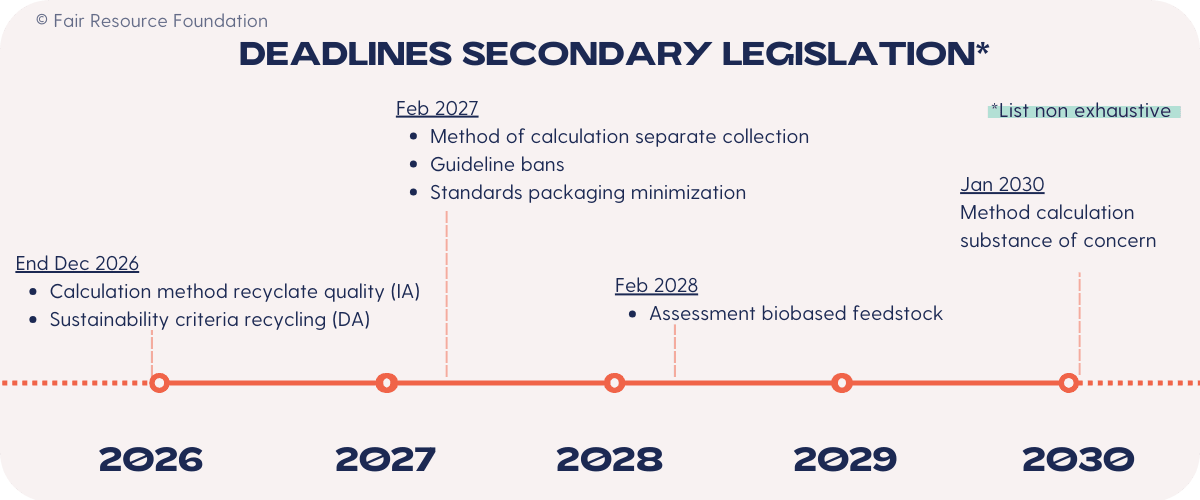
As this overview showed, a lot of secondary legislation (delegated acts and implementing acts) is still needed to clarify the targets and the way they are to be achieved. These acts are designed by the European Commission, in consultation with a diverse group of stakeholders. It is crucial that civil society organisations and environmental organisations remain involved in this process, to prevent the legislation from being watered down again as happened during the trilogue. The influence of the industry lobby in watering down the European Green Deal is well known.
Some of the key areas of focus in the secondary legislation are included in the figure below:
This page is automatically translated. A human review will follow soon.