Flemish government policy is not working: litter is increasing sharply
The figures in the OVAM report are dramatic. 22,641 tonnes of litter in 2019. The Flemish government had promised to reduce litter by 20% by 2022 compared to 2013. However, 29.4 per cent more litter was measured in 2019 than in 2013. It is estimated that 40% of litter consists of bottles and cans. […]
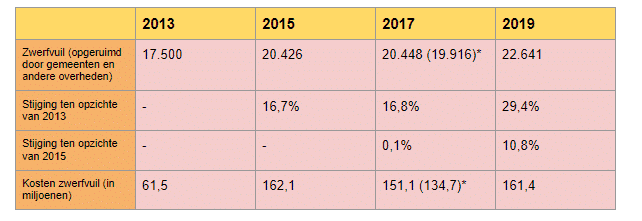

The figures in the OVAM report are dramatic. 22,641 tonnes of litter in 2019. The Flemish government had promised to reduce litter by 20% by 2022 compared to 2013. But 29.4 percent more litter was measured in 2019 than in 2013.
It is estimated that 40% of litter consists of bottles and cans. Deposit return systems reduce the number of bottles and cans in litter by 70 to 90 per cent. Eight out of ten Flemings ask for a deposit on cans and plastic bottles. Since 2017, 62% of Flemish municipalities, hundreds of organisations and companies have requested the Flemish government to introduce a deposit return system via the Statiegeldalliantie (Deposit Alliance). In July 2018, the Flemish government decided to continue the old policy with a 'waste plan'. We are now seeing the dramatic consequences of this.
Meanwhile, Mark Rutte's Dutch government decided in April this year that from 1 July 2021 there will be a deposit on all plastic bottles. No fewer than 10 EU countries decided over the past four years to introduce or expand deposit return systems in order to meet the targets of the European Single-Use Plastics Directive. In another eight European countries, deposit return systems have existed successfully for years.
Both the government of the Walloon region and the government of the Brussels region provide for a deposit return system in their coalition agreement. The federal government provides for the possibility of incorporating a deposit scheme into the packaging levy during this legislature. The immense enthusiasm for the “Deposit, Yes We Can!” campaign shows once again that livestock farmers, consumers, businesses and even banks are urging the ministers to quickly decide to introduce a deposit return system.
“While Europe and our neighbouring countries are moving faster and faster towards a nature free of bottles and cans, Flanders is becoming dirtier and dirtier. Deposit return is a proven effective method to drastically reduce bottles and cans in litter. Study after study has already shown this. Continuing to study is simply continuing to pollute. The Flemish government must now decide very quickly to introduce a deposit return system,” concludes environmental organisation Recycling Netwerk Benelux.
Despite criticism from Recycling Netwerk, OVAM changed the reference year from 2013 to 2015 in June 2020. Even if we use the modified reference year of 2015, there is still an increase of 9.8%, while litter must have fallen by 20% by 2022. That target is completely unachievable without a deposit return system.
Figures are based on the Litter and Fly-tipping Study (2019).
More info: The race to deposit return systems in Europe.
*reported by OVAM according to a 2018 study on the year 2017. The new study speaks of a higher tonnage of litter for 2017.
The figures in the OVAM report are dramatic. 22,641 tonnes of litter in 2019. The Flemish government had promised to reduce litter by 20% by 2022 compared to 2013. But 29.4 percent more litter was measured in 2019 than in 2013.
It is estimated that 40% of litter consists of bottles and cans. Deposit return systems reduce the number of bottles and cans in litter by 70 to 90 per cent. Eight out of ten Flemings ask for a deposit on cans and plastic bottles. Since 2017, 62% of Flemish municipalities, hundreds of organisations and companies have requested the Flemish government to introduce a deposit return system via the Statiegeldalliantie (Deposit Alliance). In July 2018, the Flemish government decided to continue the old policy with a 'waste plan'. We are now seeing the dramatic consequences of this.
Meanwhile, Mark Rutte's Dutch government decided in April this year that from 1 July 2021 there will be a deposit on all plastic bottles. No fewer than 10 EU countries decided over the past four years to introduce or expand deposit return systems in order to meet the targets of the European Single-Use Plastics Directive. In another eight European countries, deposit return systems have existed successfully for years.
Both the government of the Walloon region and the government of the Brussels region provide for a deposit return system in their coalition agreement. The federal government provides for the possibility of incorporating a deposit scheme into the packaging levy during this legislature. The immense enthusiasm for the “Deposit, Yes We Can!” campaign shows once again that livestock farmers, consumers, businesses and even banks are urging the ministers to quickly decide to introduce a deposit return system.
“While Europe and our neighbouring countries are moving faster and faster towards a nature free of bottles and cans, Flanders is becoming dirtier and dirtier. Deposit return is a proven effective method to drastically reduce bottles and cans in litter. Study after study has already shown this. Continuing to study is simply continuing to pollute. The Flemish government must now decide very quickly to introduce a deposit return system,” concludes environmental organisation Recycling Netwerk Benelux.
Despite criticism from Recycling Netwerk, OVAM changed the reference year from 2013 to 2015 in June 2020. Even if we use the modified reference year of 2015, there is still an increase of 9.8%, while litter must have fallen by 20% by 2022. That target is completely unachievable without a deposit return system.
Figures are based on the Litter and Fly-tipping Study (2019).
More info: The race to deposit return systems in Europe.
*reported by OVAM according to a 2018 study on the year 2017. The new study speaks of a higher tonnage of litter for 2017.
[IMAGE: https://fairresourcefoundation.org/wp-content/uploads/2024/03/20201210-Tabel-Zwerfvuil-Vlaanderen.png]
This page is automatically translated. A human review will follow soon.