The race to deposit return systems in Europe
With the announcement that the deposit system will start in 2025, Poland is fully participating in the race towards deposit return schemes among European countries. In this article, we provide an overview of where a deposit system has already been decided upon or is operational.

Last updated: April 2026.
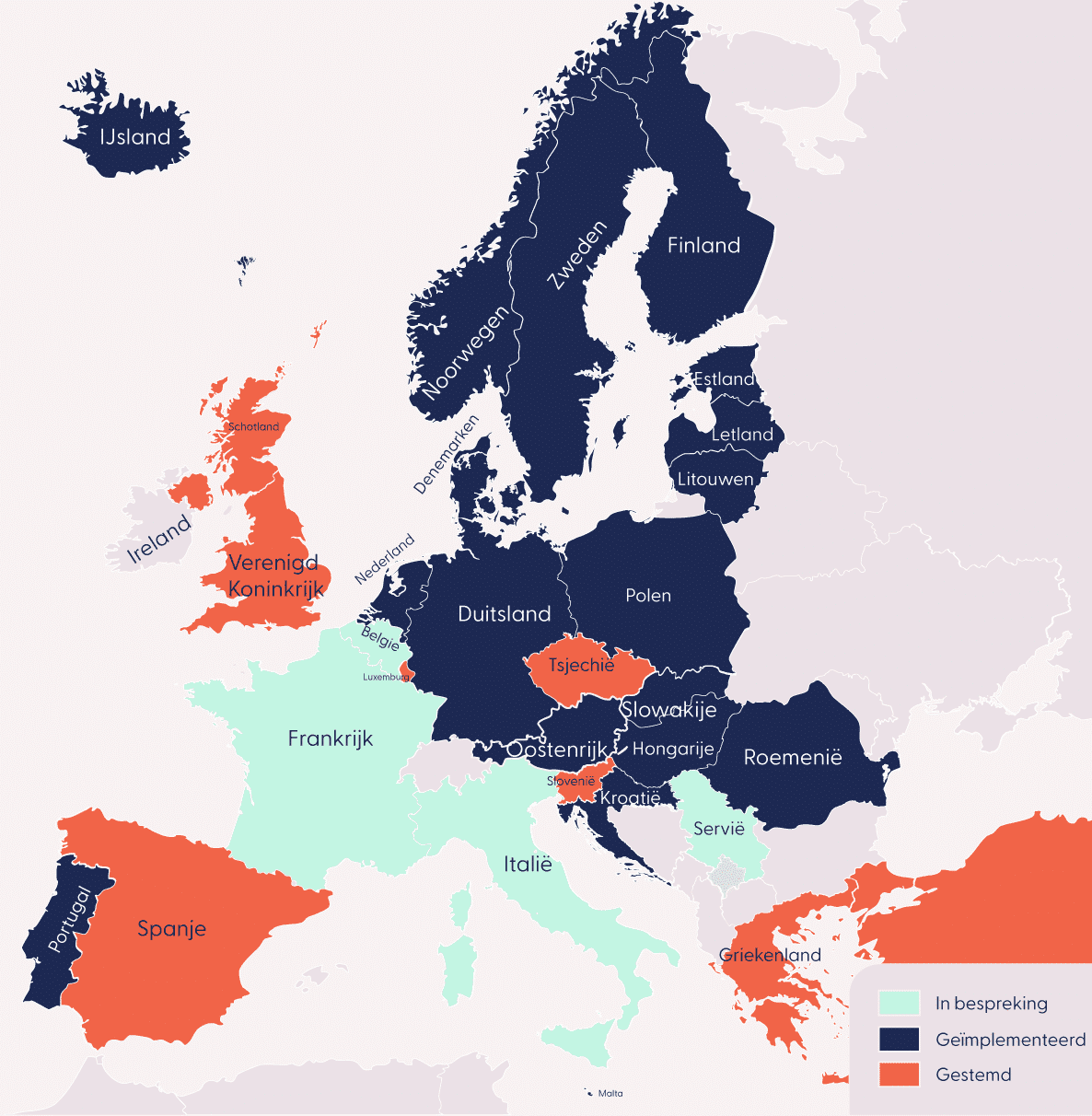
An increasing number of governments in Europe are deciding to introduce deposit return schemes for cans and plastic bottles. The pace has accelerated since the adoption of the European Single-Use Plastics Directive in 2019. The Single-Use Plastics Directive ( SUPD ) stipulates that all plastic bottles must contain at least 25% recycled content by 2025, and member states must collect 90% of plastic bottles separately by 2029. One member state after another is therefore deciding to introduce deposit return schemes in order to tackle litter and plastic pollution. In this article, we look at the decisions made by governments and parliaments in European member states. As of April 2026, there are 19 European countries (20 including Greenland) where deposit return schemes apply to plastic bottles and cans.
8 European countries with long-standing deposit return schemes
The first deposit return scheme was introduced in Dublin more than 200 years ago. It is therefore far from new. In many European countries, deposits have been levied on single-use plastic bottles and cans for decades. These countries have long achieved high collection targets and have clean streets.
Denmark introduced the first national deposit return scheme in 1922. In 1991 and 1993, it expanded to include plastic bottles. Dansk Retursystem, a private non-profit organisation, manages the system. In 2019, the system achieved a total return rate of 92%.
In Germany, the deposit return scheme has been in place for seventeen years, since 2003. There is a deposit on plastic, metal and glass beverage packaging. The standard deposit amount has been 0.25 euros since 2016. The deposit is higher for single-use packaging than for reusable packaging, such as glass bottles. 97 to 99% of single-use bottles are returned. The recycling rate for cans is around 99%. In January 2021, Angela Merkel's German government (CDU – SPD – CSU) approved a new Packaging Act, Verpackungsgesetz. The deposit on juice and alcoholic beverage packaging has been in effect since January 2022 and was extended to dairy products in 2024. Germany has had a deposit ( Pfand ) on plastic bottles and cans for a long time, since 2003. However, juices, wine and milk were excluded. The new Packaging Act therefore only looks at the packaging itself, and not at the beverage it contains.
In Estonia, a universal deposit and recycling system for single-use and refillable packaging has existed since 2005. The deposit is €0.10 on most metal, plastic and glass beverage packaging. The system is managed by Eesti Pandipakend, a producer responsibility organisation representing the Estonian Association of Brewers, the Association of Producers of Soft Drinks, the Association of Importers of Soft Drinks and Beer and the Estonian Association of Retailers.
Finland first introduced the deposit return scheme in 1952 on glass bottles, coinciding with the Summer Olympics which brought Coca-Cola to the country in glass bottles. In the 1980s, some reusable and durable plastic bottles were included in the deposit system. A deposit was introduced on aluminium cans in 1996, on PET bottles in 2008 and on recycled glass bottles in 2012. Suomen palautuspakkaus Oy (abbreviated as Palpa), a private consortium of beverage importers and manufacturers, manages the system.
Iceland has had a national deposit return scheme for plastic, aluminium and glass beverage containers since 1989.
In Croatia, since 2006, there has been a deposit of 0.5 Croatian Kuna on non-refillable containers with a minimum volume of 200 ml. Retailers larger than 200 m² are obliged to take back containers. The government manages the scheme. There is a collection target of 95%. Since 2015, the deposit scheme has ensured the return of 90% of all non-refillable packaging on the Croatian market.
Norway passed a deposit law in 1999. In 2018, the rates rose to 2 NOK for small bottles and cans and 3 NOK for large bottles. Infinitum AS (formerly Norsk Resirk) is responsible for operating the national recycling programme for non-refillable plastic bottles and beverage cans. The non-profit organisation was founded in 1999. It is owned by companies and organisations in the beverage industry and the food trade. The Norwegian system works in such a way that the environmental tax decreases as the return rate increases. This means, for example, that a 90 percent return rate for cans translates into a 90 percent discount on the environmental tax.
In Sweden, aluminium cans have had a deposit since 1984 and PET bottles since 1994. Pantamera is responsible for the deposit return scheme for aluminium cans and PET bottles. …
System introduced in 11 European countries since 2016
Tighter regulations in Europe, particularly regarding plastic packaging (Single-Use Plastics Directive, revision of the Packaging and Packaging Waste Regulation), have led several European countries to also introduce deposit return schemes since 2016.
Implementation of deposit return schemes voted in 7 countries
In addition to the actual implementation of the system, countries have also taken important steps in the right direction by voting on its introduction. These countries must then appoint a system operator and plan the concrete design of the system.
Deposit return schemes discussed in countries
As time passes, the number of countries discussing deposit return schemes without having implemented them is decreasing. These countries are also separate from those that have already introduced this measure for collecting single-use packaging. This is the case in France, Italy, Belgium and Serbia.
The race to deposit return schemes
We can therefore speak of a real race to deposit return schemes. The debate on plastic pollution is ongoing everywhere. In the member states of the European Union, intensive work is being done on legislation to address this. The pace varies from country to country, but the direction is the same.
The popularity of deposit return schemes is also rising on the borders of the European Union. In January 2019, Turkey decided that a deposit return scheme would be introduced for all beverage containers within four years. With 80 million inhabitants, Turkey will become the largest deposit country in the world after Germany.
As part of the revision of the European Packaging and Packaging Waste Regulation (PPWR), the mandatory introduction of deposit return schemes by 2029 is being discussed, along with some essential characteristics. This obligation will apply to all countries that have not yet achieved a 90% separate collection rate for plastic bottles and cans by 2029. The revised regulation will enter into force in January 2025.
This page is automatically translated. A human review will follow soon.