The end of the plastic cigarette filter is within reach
Tomorrow, the Party for the Animals will submit a motion in the House of Representatives regarding a ban on plastic cigarette filters. GroenLinks (GreenLeft) is submitting a motion for a statutory target of -70% cigarette butts in the environment by the end of 2026. In 2020, nearly 10 billion cigarettes were sold in the Netherlands. Of those, an estimated two-thirds end up [...]
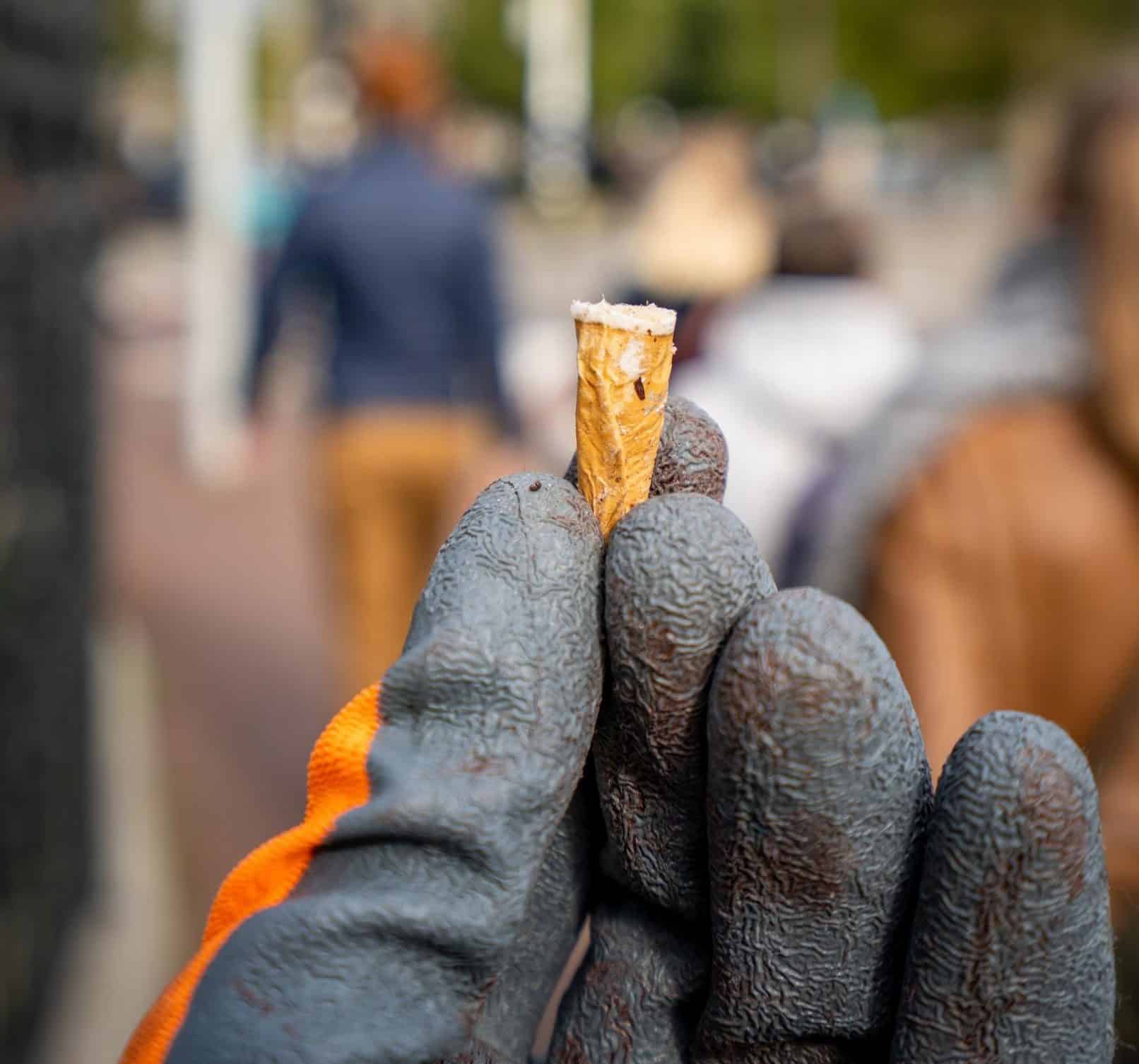

Tomorrow, the Party for the Animals will submit a motion in the House of Representatives concerning a ban on plastic cigarette filters. GroenLinks is submitting a motion for a statutory target of -70% cigarette butts in the environment by the end of 2026.
In 2020, almost 10 billion cigarettes were sold in the Netherlands. Of these, an estimated two-thirds end up on the ground or in the water. Cigarette filters are made of cellulose acetate, a type of plastic, so butts do not decompose in the environment. The Plastic Peuken Collectief is therefore calling on the government to abolish plastic cigarette filters as soon as possible.
During the annual World Cleanup Day organised by the Plastic Soup Foundation, cigarette filters are consistently the most commonly found item. During the Beach Cleanup Tour, which the North Sea Foundation (Stichting De Noordzee) organised for the eighth time last summer, 57,772 cigarette filters were cleared from the beaches in fifteen days. Most of the butts were found on the beaches of Zandvoort, Noordwijk and Scheveningen: 8,039, 6,666 and 6,152 units respectively. On the annual cigarette butt cleanup day Plastic PeukMeuk in July last year, over half a million cigarette filters were found in just two and a half hours.
"Plastic cigarette butt pollution is everywhere," says campaign leader Karl Beerenfenger. "From beaches to cities, and from car parks to schools and playgrounds. A ban on plastic cigarette filters is therefore a necessary step in combating plastic pollution," says Beerenfenger. "The tobacco industry likes to place the responsibility on the smokers themselves, but awareness alone will never end pollution, and cleaning everything up is an impossible and unaffordable task. Knowing that, we cannot imagine the government allowing this highly polluting product for much longer."
In November, former State Secretary Steven van Weyenberg of Infrastructure and Water Management responded cautiously to parliamentary questions about a ban. He cited the health benefits of the filter and the lack of an alternative as counterarguments.
Beerenfenger refutes these myths: "Research already showed in 2001 that the filter provides no health benefits, but merely an illusion of safety. The filter is simply a marketing tool to sell more cigarettes. Smoking without a filter is no less healthy. We call on the new State Secretary for Infrastructure and Water Management, Vivianne Heijnen, to tackle plastic pollution from cigarette butts. Countries worldwide are exploring how to solve the cigarette butt problem. Let's take the lead within Europe so we can show that a ban on plastic filters effectively addresses this plastic pollution. Other countries often follow a good example when national product bans are introduced."
New Zealand is putting the finishing touches on its 'Smokefree Aotearoa Action Plan', which aims to completely ban smoking by 2025 to improve water quality. In California and New York, bills are currently before the Senate that would completely ban the sale of single-use filters. In December, the Spanish Senate approved a law banning smoking on all beaches. This is because cigarette butts easily end up in the sea via beaches.
From next year, tobacco manufacturers in EU member states will have to pay for the cleanup costs of cigarette butts with plastic filters and cigarette packaging. This is established in Article 8 of the European Single Use Plastics Directive (SUPD), which came into force last summer. The measure will be evaluated in 2026.
Rob Buurman, director of environmental organisation Recycling Netwerk Benelux, says: "Pending a ban, we call on the Dutch government to closely monitor the number of littered cigarette butts and to set realistic cleanup costs per butt. In this way, the government can motivate tobacco manufacturers to prevent cigarette butts from ending up in the environment. As an incentive, we propose that the government includes a statutory target of -70% cigarette butts in the environment by the end of 2026. We expect that only a ban will be effective in achieving these targets. We saw the same with the introduction of deposit schemes: the industry was given years of leeway, but only when the government introduced deposits on plastic bottles did fewer of them end up in the environment. In 2021, various single-use plastic products were banned by the European Union, such as cutlery, plates and straws. The European Union missed an opportunity back then to include plastic cigarette filters in the ban list. The Dutch House of Representatives can rectify this," Buurman concludes.
Contact interviews
Karl Beerenfenger
Campaign Leader
Two-minute debate
Follow-up to the Committee Debate on Circular Economy dated 18 November 2021.
Plastic Peuken Collectief
The Plastic Peuken Collectief is a national partnership of dozens of environmental organisations and companies. The collective is supp
Tomorrow, the Party for the Animals will submit a motion in the House of Representatives concerning a ban on plastic cigarette filters. GroenLinks is submitting a motion for a statutory target of -70% cigarette butts in the environment by the end of 2026.
In 2020, almost 10 billion cigarettes were sold in the Netherlands. Of these, an estimated two-thirds end up on the ground or in the water. Cigarette filters are made of cellulose acetate, a type of plastic, so butts do not decompose in the environment. The Plastic Peuken Collectief is therefore calling on the government to abolish plastic cigarette filters as soon as possible.
During the annual World Cleanup Day organised by the Plastic Soup Foundation, cigarette filters are consistently the most commonly found item. During the Beach Cleanup Tour, which the North Sea Foundation (Stichting De Noordzee) organised for the eighth time last summer, 57,772 cigarette filters were cleared from the beaches in fifteen days. Most of the butts were found on the beaches of Zandvoort, Noordwijk and Scheveningen: 8,039, 6,666 and 6,152 units respectively. On the annual cigarette butt cleanup day Plastic PeukMeuk in July last year, over half a million cigarette filters were found in just two and a half hours.
"Plastic cigarette butt pollution is everywhere," says campaign leader Karl Beerenfenger. "From beaches to cities, and from car parks to schools and playgrounds. A ban on plastic cigarette filters is therefore a necessary step in combating plastic pollution," says Beerenfenger. "The tobacco industry likes to place the responsibility on the smokers themselves, but awareness alone will never end pollution, and cleaning everything up is an impossible and unaffordable task. Knowing that, we cannot imagine the government allowing this highly polluting product for much longer."
In November, former State Secretary Steven van Weyenberg of Infrastructure and Water Management responded cautiously to parliamentary questions about a ban. He cited the health benefits of the filter and the lack of an alternative as counterarguments.
Beerenfenger refutes these myths: "Research already showed in 2001 that the filter provides no health benefits, but merely an illusion of safety. The filter is simply a marketing tool to sell more cigarettes. Smoking without a filter is no less healthy. We call on the new State Secretary for Infrastructure and Water Management, Vivianne Heijnen, to tackle plastic pollution from cigarette butts. Countries worldwide are exploring how to solve the cigarette butt problem. Let's take the lead within Europe so we can show that a ban on plastic filters effectively addresses this plastic pollution. Other countries often follow a good example when national product bans are introduced."
New Zealand is putting the finishing touches on its 'Smokefree Aotearoa Action Plan', which aims to completely ban smoking by 2025 to improve water quality. In California and New York, bills are currently before the Senate that would completely ban the sale of single-use filters. In December, the Spanish Senate approved a law banning smoking on all beaches. This is because cigarette butts easily end up in the sea via beaches.
From next year, tobacco manufacturers in EU member states will have to pay for the cleanup costs of cigarette butts with plastic filters and cigarette packaging. This is established in Article 8 of the European Single Use Plastics Directive (SUPD), which came into force last summer. The measure will be evaluated in 2026.
Rob Buurman, director of environmental organisation Recycling Netwerk Benelux, says: "Pending a ban, we call on the Dutch government to closely monitor the number of littered cigarette butts and to set realistic cleanup costs per butt. In this way, the government can motivate tobacco manufacturers to prevent cigarette butts from ending up in the environment. As an incentive, we propose that the government includes a statutory target of -70% cigarette butts in the environment by the end of 2026. We expect that only a ban will be effective in achieving these targets. We saw the same with the introduction of deposit schemes: the industry was given years of leeway, but only when the government introduced deposits on plastic bottles did fewer of them end up in the environment. In 2021, various single-use plastic products were banned by the European Union, such as cutlery, plates and straws. The European Union missed an opportunity back then to include plastic cigarette filters in the ban list. The Dutch House of Representatives can rectify this," con
Contact interviews
Karl Beerenfenger
This page is automatically translated. A human review will follow soon.



