The long road to deposit return schemes in the Netherlands: the timeline
On Saturday 10 March 2018, State Secretary Stientje van Veldhoven informed the House of Representatives by letter about the introduction of a deposit scheme on plastic bottles and about making the packaging chain circular, with the Packaging Framework Agreement as a key focus. That same Saturday, a major interview with the State Secretary on the introduction of deposits on plastic bottles was published in the Trouw newspaper.

This page is automatically translated. A human review will follow soon.
In the interview, Van Veldhoven is confident that the approach “one way or another, will succeed.” In the spring of 2021, there will be a deposit on small plastic bottles containing water and soft drinks, according to the letter to the House of Representatives, unless the business community manages to reduce the number of bottles in the environment by 70 to 90% and succeeds in recycling 90% of small plastic bottles.
This article is an explanation of the State Secretary's decision and the timeline leading up to the spring of 2021, at which point small plastic bottles must be subject to a deposit if the business community does not achieve the targets. The article discusses the context in which the decision was reached and the political debate that followed. Where there are still ambiguities regarding the process up to and including the spring of 2021, the article attempts to highlight them as carefully as possible.
The petition motion
To interpret the State Secretary's letter, it is useful to first look back at the origins of the so-called ‘petition motion’ by the Plastic Soup Surfer. In 2016, Merijn Tinga, alias the Plastic Soup Surfer, started a petition to get the subject of deposits onto the agenda of the House of Representatives as a citizens' initiative.
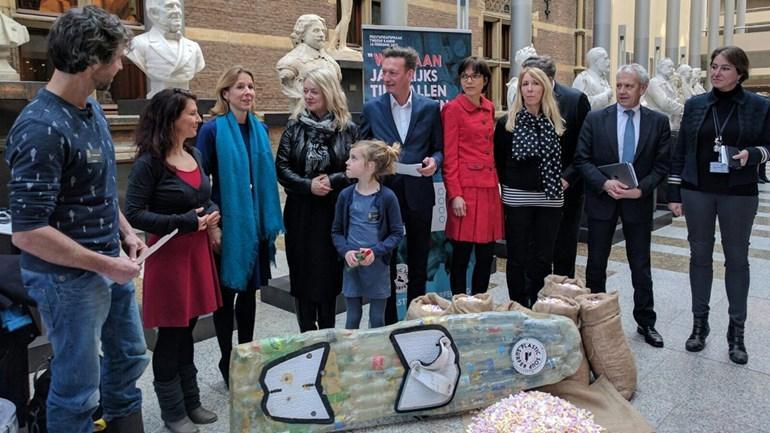
With 55,000 candy hearts, Merijn headed to the House of Representatives on 14 February 2017 and presented just as many signatures to politicians. The politicians present, including Agnes Mulder (CDA), Carla Dik-Faber (CU), Liesbeth van Tongeren (GroenLinks), Henk Krol (50PLUS), Stientje van Veldhoven (D66), Erik Ziengs (VVD), Tjeerd van Dekken (PvdA), Eric Smaling (SP), and Esther Ouwehand, were also asked on the spot whether they would back the target of achieving 90% fewer plastic bottles in the environment within 3 years. That target was endorsed by all politicians present.
Two days later, on 16 February 2017, the recurring General Consultation on Circular Economy took place. It was the last ‘AO’ before the elections of 15 March 2017. The agenda included the Plastic Soup Surfer's initiative. In that consultation, Eric Smaling (SP) referred to Merijn's action as the ‘petition motion’, and in the same consultation, former State Secretary Sharon Dijksma (PvdA) promised that the government would adopt the objective of that ‘virtual motion’, which likely also represented a unique event in parliamentary history. Dijksma also promised to present a proposal by autumn 2017 for a 90% reduction of small plastic bottles in litter within 3 years. Dijksma also stated that the broad support for the target meant that the House of Representatives was calling for additional measures.
In the letter of 23 May 2017, State Secretary Dijksma addresses the implementation of the ‘petition motion’. In it, she also indicates that price incentives such as deposits cannot remain off the table in order to achieve the target. The State Secretary also stated that she would be able to make a well-substantiated statement on the feasibility of the petition motion by the end of 2017. By that time, the ongoing study into the costs and effects of deposits should also be completed.
The Rutte III cabinet was sworn in on 26 October 2017, with State Secretary Sharon Dijksma being succeeded by Stientje van Veldhoven.
The Deposit Study
On 31 August 2017, Dijksma informed the House of Representatives via a letter about the study “Costs and effects of a deposit on small plastic bottles and cans.” The study had been promised in the AO Circular Economy of 5 October 2016 and was conducted by CE Delft.
The letter briefly describes several results of the study, which specifically addresses the Dutch situation where an expansion of the current system is being considered. The researchers conclude that a deposit on small bottles and cans leads to a decrease of these products in litter in the range of 70 to 90%. The letter also indicates that the costs of expanding a deposit system “can vary from €10m to €110m per year depending on the chosen variant.”
The letter fails to mention that, due to unreturned bottles and receipts, the deposit system also generates revenue varying from €31m to €121m per year depending on the chosen variant. This revenue helps offset the aforementioned costs for the business community.
Nor does the letter mention that the expansion of deposits leads to savings on collection via the current systems (e.g. Plastic Heroes) in the range of €5.5m to €8.0m per year depending on the chosen variant.
The study also calculates that the expansion of deposits yields carbon savings in the range of €3.5m to €27.0m per year, depending on the chosen variant and depending on the cost attributed to CO2. A further saving of €3m to €10m is estimated because municipalities will need to empty public waste bins less frequently.
And finally, the study indicates that municipalities can save up to an additional €80m annually on litter clean-up. This saving is achieved if municipalities continue to aim for the same level of cleanliness as before the introduction of deposits. Litter clearance is then carried out less frequently. The maximum saving is therefore dependent on the choices municipalities make, but the amount does indicate which costs would no longer need to be incurred for clearing up small plastic bottles and cans.
None of the aforementioned revenues and cost savings are mentioned in Dijksma's letter, which therefore presented an incomplete and distorted picture of the actual benefits and costs of introducing a deposit scheme.
The CE Delft analysis showing that deposits lead to 70% to 90% fewer bottles and cans in litter is important. The range is based on measurements from the United States and Denmark. The CE Delft study did not attempt to explain why the effectiveness of deposits varies across the different US states and Denmark, but this could, for example, depend on the level of the deposit amount and the ease with which the bottles and cans can be returned.
As a result of the CE Delft study, a deposit is the only measure proven capable of achieving the target from the ‘petition motion’ of 90% fewer bottles in litter within 3 years, potentially with additional accompanying policy should the effectiveness fall below 90%.
Schoon Belonen (Clean Rewards)
The letter of 23 May 2017 also mentions a different type of price incentive than a deposit. Under the banner of Schoon Belonen (Clean Rewards), Stichting Natuur & Milieu, VNG, and the packaging industry took the initiative to test reward systems for bottles and cans in practice. Under this scheme, schools and clubs received a collective fee or a reward in return for the bottles and cans they collected. 102 municipalities signed up for the pilot, and ultimately 77 municipalities actively participated, according to the initiators.
In the letter of 18 June 2015 to the House of Representatives, State Secretary Wilma Mansveld (PvdA) speaks for the first time about a nationwide approach to litter. Part of that approach is the development of a return-reward system for small PET bottles and cans. In the letter, Mansveld states that “all parties [have been] asked to think about a creative approach for small PET bottles and cans.” In an appendix to the letter (“Packaging Coalition Proposal”, date: 16 June 2015), the Afvalfonds, VNG, NVRD, and Stichting Natuur & Milieu propose to present an action plan before 1 October 2015, in which the parties involved “carry out various extensive experiments in neighbourhoods, districts, and villages for the collection of small PET bottles, beverage cans, and possibly other packaging materials.” Based on this pilot, a nationwide plan was to be introduced by 1 January 2018, according to the letter from the ‘packaging coalition’.
In the letter of 14 October 2015 to the House of Representatives, Mansveld presents the packaging coalition's action plan. Schoon Belonen was to be launched on 1 January 2016, and the pilot would be evaluated at the end of 2017. During the VAO Raw Materials and Waste on 1 September 2015, a motion by MPs Yasmin Çegerek and Stientje Van Veldhoven was tabled and ultimately adopted. The motion asks to “guarantee a sound design of the study by, among other things, ensuring a scientifically justified determination of the research framework, a proper baseline measurement, and adequate monitoring, with a statement of approval of the design, measurement data, and conclusions by an independent organisation.” State Secretary Mansveld subsequently asked Rijkswaterstaat as an independent party to develop the baseline measurement and further monitoring to determine the effect of the Schoon Belonen Pilot.
As agreed, the evaluation of the Schoon Belonen pilot was delivered by Rijkswaterstaat at the end of 2017. Together with the letter of 28 November 2017, State Secretary Stientje van Veldhoven sent the relevant report, “Monitoring Report Pilot Schoon Belonen”, to the House of Representatives.
The core of the evaluation concerns the question of whether the Schoon Belonen Pilot led to fewer bottles and cans in litter within the participating municipalities. For this purpose, baseline measurements of the numbers of bottles and cans in litter were carried out in May 2016 (measurement 1) and September 2016 (measurement 2). In May 2017 (measurement 1) and September 2017 (measurement 2), the number of bottles and cans in litter was measured again across the municipalities participating in the pilot. By comparing the results from 2017 with 2016, the effect of the pilot was to be evaluated.
For measurement 1, a slight increase in bottles and cans was observed in 2017. For measurement 2, there was a decrease of 19% in PET bottles and 36% in cans in litter. Based on measurement 1, there therefore appears to be no positive effect, but based on measurement 2, the pilot does seem to yield a significant positive effect. Rijkswaterstaat then compared the results with the broader national monitoring, thus including areas where the pilot was not carried out. This revealed that in the period of measurement 1, 2 to 3% more bottles and cans were found across the country as a whole. In the period of measurement 2, a decrease of 36% was observed for both bottles and cans. By comparing the results of the pilot with the national results, it turned out that no broad significant positive effect of the pilot was observed. Only in the immediate vicinity of participating schools and clubs (a very limited share of the municipal area) could a positive effect
Although the results of the Schoon Belonen Pilot show scarcely any positive effect on litter, the initiators state in the letter of 17 November 2018 addressed to the State Secretary that the results of the pilot offer starting points
for making elements of Schoon Belonen part of the broad national approach to litter. Schoon Belonen was said to have a positive effect on civic engagement.
State Secretary Dijksma already indicated in 2017 that price incentives cannot remain off the table in order to achieve that target of 90% fewer plastic bottles in the environment within 3 years. The CE Delft study on the costs and effects of deposits showed that deposits can help achieve the target. The evaluation of Schoon Belonen shows that this ‘alternative to deposits’ has a minimal effect on litter.
Demand for introduction of deposit scheme grows
In 2012, former State Secretary Joop Atsma (CDA) reached an agreement with the business community that deposits on large bottles could be abolished, provided that seven conditions were met. Those conditions were laid down in the Packaging Framework Agreement. In 2015, his successor Wilma Mansveld concluded that the business community had failed to meet the condition of removing PVC packaging from supermarkets, meaning that deposits were definitively not released.
Since then, support for expanding deposits has grown. The 55,000 signatures collected by the Plastic Soup Surfer are a sign of this. Surveys conducted among the Dutch population also show that public support is very high and growing.
At the end of 2016, Radar conducted a survey among 1,500 of its own panel members, which showed that 74% supported the expansion of deposits to small plastic bottles and cans.
In early 2018, Radar asked 40,000 test panel members once again what they thought of expanding the deposit scheme. This time, 80% responded positively.
In early 2018, the Consumentenbond also asked 2,000 members what they thought of expanding the deposit scheme. 84% of respondents reacted positively to the expansion for small bottles, and 75% support the expansion of deposits to cans.
Finally, in early 2018, both Recycling Netwerk (GfK, 24,979 respondents) and EenVandaag (33,270 respondents from the EenVandaag opinion panel) polled support for deposits among voters of political parties. The results of these polls support each other. Respectively 79% (GfK) and 78% (EenVandaag) of those surveyed support the expansion of deposits. Support is also high among voters of the coalition parties. Among CDA voters, according to both polls, 83% favour expansion, and for the VVD that figure is 79% (GfK) and 72% (EenVandaag). Among D66 (85% GfK; 89% EenVandaag) and ChristenUnie (85% for both GfK and EenVandaag), support for the expansion of deposits is very high.



