[Position paper] Towards ambitious deposit return systems across Europe
Although the general ambitions of the Packaging and Packaging Waste Regulation (PPWR), particularly regarding reuse, have been significantly watered down by industry lobbies, we nevertheless welcome the direction for deposit return systems (DRS) in the new revision of the PPWR. With this joint letter – signed by 50 European organisations – we offer our comments on the regulation, which designates DRS as a solution to increase separate collection, promote reuse and harmonise the collection of beverage packaging in Europe.

Legislation laying the foundation for future-proof European Deposit Return Systems
In our view, the PPWR provides a clear direction on what deposit return systems must achieve. We appreciate that the European institutions:
Recognise deposit return as the most effective solution to meet the ambitious target for the separate collection of plastic bottles and cans. This by making deposit return mandatory for all Member States, unless they achieve the final 90% target through other means (see the next section for a more detailed assessment). This is perfectly logical, as no Member State has achieved these ambitious targets without a deposit return system;
Pave the way for deposit return for reusable packaging. The revised PPWR not only supports an international movement towards deposit return systems for single-use packaging, but also encourages the use and scaling up of deposit return towards reuse. This is done by asking Member States to ensure that deposit return systems for single-use packaging are "equally available for reusable packaging where technically and economically feasible" (Article 44(6)). Furthermore, the PPWR specifically mentions glass packaging as low-hanging fruit in this transition to reuse. DRS is even mentioned as one of the measures that can help Member States scale up reuse and refill (Article 45);
Support the harmonisation of deposit return systems in Europe: we see the essential requirements (Annex X) as a way to harmonise systems and increase interoperability between national systems, particularly new ones. However, we regret that the expected harmonisation for countries that already have a sub-optimal deposit return system is only anticipated from 2035 (Article 44(9)), making interoperability more difficult. We hope that countries with existing systems will also strive to align with these requirements.
Chloé Schwizgebel, Fair Resource Foundation: "With this revision of the PPWR, deposit return is clearly flagged as a stepping stone to reuse and closed-loop recycling. We welcome the ambitions for effective and harmonised deposit return systems across Europe. We hope this will encourage countries that do not yet have a deposit return system to improve their approach."
Enzo Favoino, scientific coordinator at Zero Waste Europe: "The structure of the final provisions on deposit return in the PPWR sets a clear roadmap towards the introduction of deposit return systems across Europe, as a key element to maximise circularity for the targeted materials and to combat littering, which is an operational and economic burden for local communities. The final target of 90%, and the compelling need to meet it in 2029, make it inevitable to start planning for a broad rollout of DRS, including in Member States that currently have no plan for this."
Alexis Eisenberg, Director France and Francophonie at Reloop: "We welcome the implementation tool of the deposit return system if the collection rate of plastic bottles and cans does not reach 80% in 2026. We rely on the PPWR and deposit return as a tool to support European consumers in the transition to reuse and to maximise material circularity. We count on the PPWR to accelerate the circular economy in Europe."
Watch out for loopholes along the way
Despite the overall positive text on DRS, it is essential to be aware of some shortcomings resulting from the amendments and provisions to the Commission's original text:
Inconsistency in timing: potential exemptions are linked to the reporting of separate collection by Member States. While a European methodology already exists for measuring the separate collection of plastic bottles (see SUP Implementing Decision 2021/1752), a harmonised methodology for cans will only be known 24 months after the entry into force of the revised PPWR (Article 50(7)). Even more concerning is that reporting is only expected from calendar year 2028 and must be reported by mid-2030 (Article 50(3) and (4)). This creates room for undesirable delays and unharmonised reporting, as Member States can report separate collection of cans based on national data until 2028.
Unclear exemptions: Member States can request an exemption from the mandatory deposit return system if they achieve 80% separate collection in 2026, with the simultaneous submission to the Commission of an implementation plan to achieve 90% (Article 44(3)(a) and (b)). Without a European, consistent methodology for calculating the separate collection of cans (before 2026) or clear guidelines for the requirements of the implementation plan (before 2028), we fear a legal vacuum that opens the door to regrettable (and misleading) exemptions. We point out Article 44(5) here, which makes the introduction of DRS mandatory for all Member States, including those temporarily exempted in 2026, if they fail to achieve 90% separate collection by 2029. This is consistent with the SUP target for PET bottles. The temporary exemption therefore does not detract from the final 90% target.
Confusing exemption from the take-back obligation: the take-back obligation is an essential part of an effective deposit return system, as it protects consumers by ensuring they can get their money back wherever beverage packaging is sold. One of the final provisions causes confusion by allowing an exemption from this essential obligation (Annex X (l)). The wording of the exemption is not only unclear, but also out of line with the PPWR's ambitions to promote reuse, because the exemption is based on criteria for food-safe recycling.
What is the next step on the European path to DRS?
The PPWR has the potential to provide a clear roadmap for countries that have yet to plan the introduction of a deposit return system for plastic bottles and cans, such as Belgium, Italy, France, Portugal or Spain. We are pleased with the fact that the PPWR also confirms the role of deposit return towards reuse, by enabling the necessary organisational and behavioural change.
However, for deposit return to remain a strong and ambitious environmental measure, the European institutions must provide clarity on expectations around DRS in the PPWR. For example, by drafting clearer guidelines for the exemptions, emphasizing the key role of the final 90% target. But also by requesting data on cans that follow a European methodology for an exemption request, instead of national data, to ensure fair and comparable assessments across all Member States.
Position paper co-signed by:
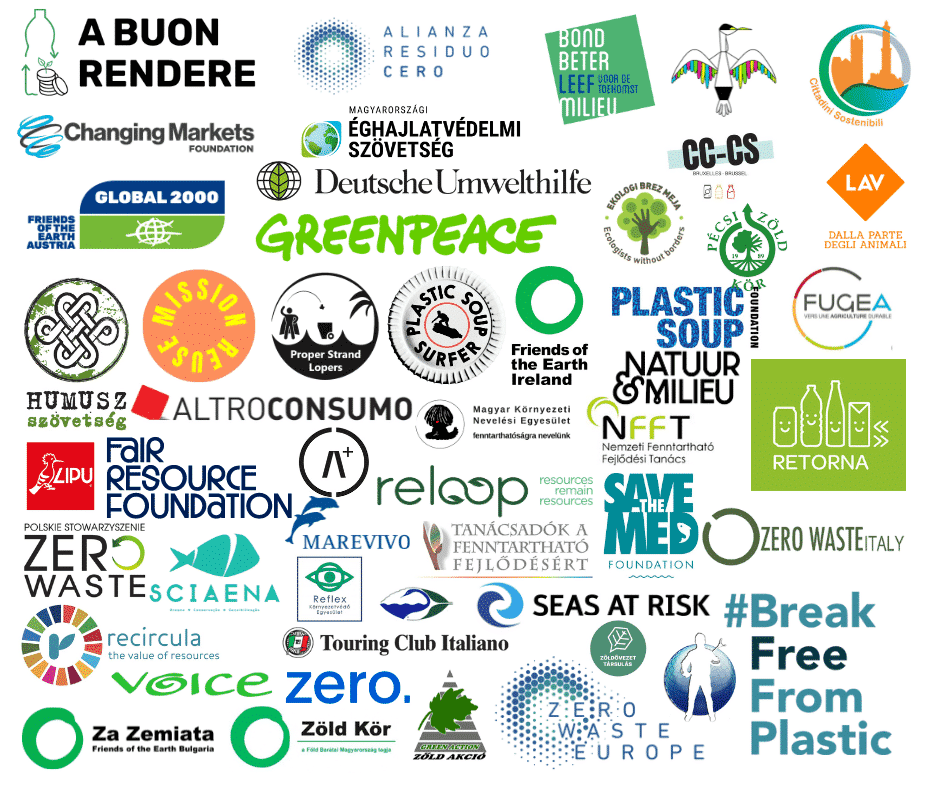
GLOBAL 2000 (Austria)Bond Beter Leefmilieu (Belgium)Canal It Up (Belgium)CCB (Belgium)Fugea (Belgium)Greenpeace Belgium (Belgium)Proper Strandlopers (Belgium)Za Zemiata (Bulgaria) Reloop (France)Deutsche Umwelthilfe (Germany)Éghajlatvédelmi Szövetség (Hungary)Humusz Szövetség (Hungary)Kétker Közösségi Alapítvány (Hungary)Magyar Környezetvédelmi Egyesület (Hungary)Pécsi Zöld Kör (Hungary)Reflex Környezetvédő Egyesület(Hungary)
Tanácsadók a Fenntartható FejlődésértZöld Akció Egyesület (Hungary)ZÖLD KÖR (Hungary)Zöldövezet (Hungary)Polish Zero Waste Association (Poland)Friends of the Earth (Ireland)Voice (Ireland)A Buon Rendere (Italy)Altroconsumo (Italy)Cittadini Sostenibili (Italy)Fondazione Marevivo (Italy)LAV Lega Anti Vivisezione (Italy)Lega Italiana Protezione Uccelli (Italy)Società Italiana di Ecologia (Italy)TCI Touring Club Italiano (Italy)Zero Waste Italy (Italy)
Mission Reuse (Netherlands)Natuur & Milieu (Netherlands)Plastic Soup Foundation (Netherlands)Plastic Soup Surfer (Netherlands)Zwerfinator (Netherlands)Sciaena (Portugal)Zero (Portugal)Ekologi brez meja (Slovenia)Alianza Residuo Cero (Spain)Asoc Retorna (Spain)Recircula (Spain)Save the Med (Spain)Break Free From Plastic EuropeChanging Markets Fair Resource Foundation Seas at RiskZero Waste Europe
This page is automatically translated. A human review will follow soon.